Thursday, April 20, 2017

Kurt Cobain And The Martin D-18E Guitar

Kurt Cobain And The Martin D-18E Guitar

That the music of Nirvana changed the music scene when it became popular in about the year 1993 is unquestionable. That Nirvana was most often a heavy hitting electric band full of screaming guitars, vocals, and thumping drum and bass rhythm section is also simply fact. The very last album by the band which put grunge music on the map, however, was an all acoustic album. MTV Unplugged In New York was that final album[1], and that is where Nirvana left us forever, with a brooding, depressing, beautiful acoustic album.
While the unplugged genre of live albums was becoming a thing rather popular for otherwise plugged in bands or artists to do, it was also something which allowed us to see such musicians were actually capable of playing in other formats. There's really a bit of a transition to deal with for a guitarist when switching from electric to acoustic guitars. Oh they're the same instruments, but the acoustic variety of guitar requires the use of much bigger strings, and those put a lot more stress on both the picking or strumming hand, and especially the fret board hand. Kurt Cobain, however, was always primarily a rhythm guitarist on either electric or acoustic.
The MTV Unplugged In New York album by Nirvana would prove to be their swan song. The music was mostly a mix of tunes which were written by other artists, and a few of the band's own lesser known songs. It gave us all a new way to think of those three musicians we thought we'd known so well, and a chance to literally hear what it sounded like for Kurt Cobain to say "goodbye" to us all.
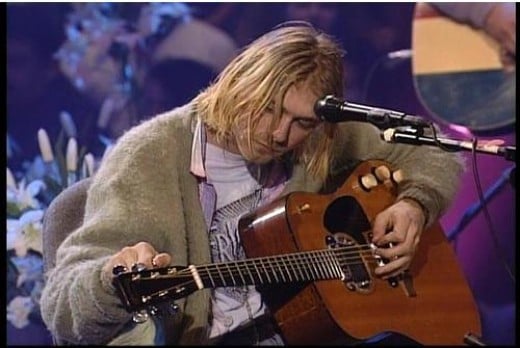
So What Exact Guitar Was Kurt Cobain Playing In The MTV Unplugged Concert? Answer: Cobain Played The Martin D-18e

The live acoustic album by Nirvana, their final album, sounded terrific, and it still does. While it would be near impossible to duplicate the emotional vocals and quirks presented in the show by Kurt Cobain, what isn't impossible is to have the same guitar as he had. The guitar is a Martin D-18, one of the most admired and famous acoustic guitars in the world.
The exact year of Kurt's D-18 is 1958, and this guitar is extremely rare. This guitar, with three pickups on it, isn't something one is ever likely to come into contact with; and so it is a very collectible instrument. The three pickups are two DeArmonds pickups, and one Bartolini pickup. It is rumored that during the MTV Unplugged concert, only the Bartolini pickup was working for Kurt. Another thing which is perfectly obvious from the images is this specific instrument is a right handed model. Kurt Cobain was a left handed guitarist, and so he simply flipped the stringing of the instrument around to where it would be normal for a left handed musician to play.
I'm told Kurt's setup was stomp box distortion pedal ran into a Fender SF Twin Reverb amplifier The thing most important to note here is that the 1958 D-18e was a very good acoustic guitar with very old and not so wonderful pickups on the thing. If someone wanted to achieve a sound comparable or even superior to what Kurt had achieved in the Unplugged In New York concert, they could do so with a much less expensive and more modern instrument with modern pre-amp and pickups on the thing.
So far as alternate guitars built to Martin D-18 specifications but sold at a far more reasonable price goes, I will forever and ever advise one to purchase a Blueridge BR-140, which is an absolutely terrific Chinese version of the D-18 and is all solid wood, built to Martin specs, and can be purchased brand spanking new for less than six hundred dollars. There are other fine alternatives instruments as well. No one should mistreat a D-18 by putting pickups onto it unless they're just that willing to be disrespectful to something so wonderful as a D-18, and so unworthy of abuse. There are many a fine mahogany body Alvarez, Yamaha, and Takamine instruments out there available new or used where one can either purchase with the electronics, or without the electronics and then add the most modern ones available for the best possible sound. Outside of the mahogany body steel string flat top dreadnought design, the most important things to consider for replicating this Nirvana tonality of the unplugged variety would be the stomp box distortion pedal and the Fender SF Twin Reverb amp.

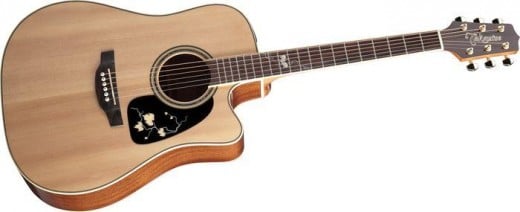
The Takamine 50th Anniversary G Series Acoustic-Electric Guitar

akamine 50th Anniversary Edition G Series Acoustic-Electric Guitar Natural

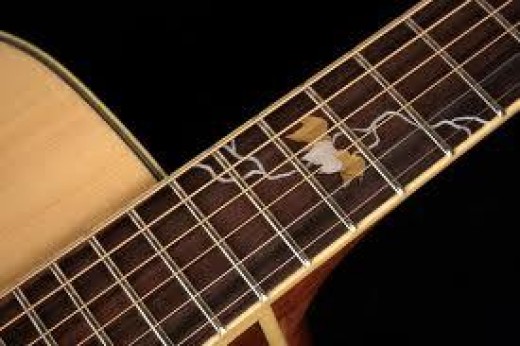
With a solid sitka spruce top as a sound board and mahogany back and sides, the Takamine fifty anniversary G series acoustic electric is more than just another great guitar from Takamine, it is a commemorative and rather ornate one too. This is the first limited edition G series guitar in Takamine's fifty years of providing high quality guitars to the world for a very good price. These guitars are available in both cutaway and traditional dreadnought configurations; and are rather ornate for their fiftieth anniversary abalone vine inlay on the fret board.
With a mahogany body and sitka spruce top, this guitar will be loud, and notes will be more distinct and clear than a rosewood instrument. Plugged in, however, and played on stage is where this instrument will most shine. It is a beautiful steel string axe, and meant to be a stage instrument for a travelling musician. Some of the world's finest virtuoso acoustic players, men such as Brad Davis, are playing Takamine guitars on stage so as to keep that fine Martin D-28 or D-18 at home for use in the studio. These Takamine instruments come with above and beyond the pale electronics which optimize their efficiency and utility on stage.
For only seven hundred dollars this instrument is an amazing value. Many such high quality and high value Japanese instruments are available, but this one is more attractive than some others for its inlay present on the fret board and the pick guard. The Takamine 50th anniversary G series is a much more affordable and practical guitar than the Takamine 40th Anniversary guitar. The 40th anniversary instrument is the kind of flat top one keeps at home, and the 50th anniversary six stringer one to use to play live in a club or on any stage anywhere.
This commemorative fortieth anniversary dreadnought comes ready to plug in, and with Takamine's fine electronics, which have a well deserved stellar reputation, you can't be left feeling like you've got anything but the best to work with. The TP4T preamp system and the CP100 pickup are yours to use and play your magic for the crowds. The electronics on this guitar will bring out the best acoustic clarity possible.

Takamine 50th Anniversary "Growing Vine" inlay

Takamine 50th Anniversary G Series Specifications

  • Gloss finish for radiant shine and beauty
  • Venetian style cutaway for access to upper frets
  • Dreadnought body design
  • Solid sitka spruce sound board for volume and tonal clarity
  • Mahogany back and sides providing maximum tonal velocity
  • Mahogany neck
  • Scalloped X bracing
  • Rosewood veneer peg head
  • Gold rosette
  • Growing vine inlay on pick guard and fret board
  • Gold peg head Takamine logo
  • Gold tuning machines
  • Standard one and eleven sixteenths neck width at nut
  • Rosewood fretboard with vine fret board inlay
  • Nickel silver frets with with black positioning markers on the side of the neck
  • CP100 pickup and TP4T pre-amp Q1BZ1
The design and themes of this guitar will never again be duplicated by Takamine. Once these instruments go out of production they'll never be produced again. This is the first limited edition G series guitar Takamine has ever produced, and it may be the last one as well. At just seven hundred dollars this guitar is everything one expects in a Japanese acoustic electric guitar, and exemplifies the high value of Japanese instruments.
 This six string original would not just make a fine stage instrument, but is also bound to wind up a collectible instrument as well. I've priced these guitars in used models on the web for as low as three hundred and fifty dollars, but those should only be purchased should one be comfortable with some scratches and scuffs from use in live music venues anywhere on this planet where musicians perform with fine instruments such as these.

The Martin J-15, A Jumbo Sized Inexpensive Masterpiece

The Martin J-15, A Jumbo Sized Inexpensive Masterpiece

Why A Jumbo Guitar?

People come in all shapes and sizes, two sexes, and various ambiguities. In our lives a lot of us get a desire for a time, or for a lifetime, to make music. It's a simple fact the guitar is the most often used and desired instrument[1] of the inspired musician. Every musical instrument is desirable and capable of making beautiful tonal artwork, but for whatever reason, it is the guitar most choose to use to see if they're music making desire is for a time, or forever.
It's a simple fact the acoustic variety of the six stringed instrument we all know and love so well is the more favorable one for many an occasion, and this is certainly due to its not needing any sort of assistance for play from electricity or electrical gadgetry. The larger the guitar, the more sound the guitar can provide would be a general rule, but we all know there are many more factors involved, specifically, the quality of the wood, and the talents and education of the builder. It goes quite without saying that the builders down a C.F. Martin & Company are among the best in the world. Martin guitars was established in the USA in 1833, and probably, the Martin family were building guitars prior to immigrating to here.

Specifications

The Martin J-15 is not constructed with the classic dovetail neck joint, but rather, with the more modern Mortise/Tenon neck joint, which is a more modern, cost and time effective means of connecting the neck of a fine guitar to the body. The guitar is the standard 14 frets clear of the body. This guitar is constructed with all the master workmanship seen in ALL all solid wood construction Martin instruments, but the 15 series instruments are built to be not just heirloom quality instruments, but affordable ones. What this means is some less expensive materials are used. When I say "less expensive," it would be a huge mistake to assume this meant "cheaper." The bridge and finger board or fret board on this guitar are both constructed using rosewood. Rosewood is NOT a lesser wood than ebony for such things, it is ONLY a less expensive wood than ebony.
Now, the tricky thing to discuss with this fine Martin J-15 steel string instrument is this, the woods used for the top and the body. This same bit of issue is the same with all Martin 15 series instruments. Martin regards sapele and mahogany as identical woods. They are nearly the exact same thing, but they are not exactly the same thing. Some 15 series instruments will have one for the body/sides, and the other for the top, or vice versa. I'm told the older Martin 15 series instruments were all mahogany, and the newer ones are all sapele. C.F. Martin guitars and Taylor guitars both consider sapele and mahogany as so very similar as to be the same. This particular subject is one which is often discussed on guitar forums[2], and probably will be for a significant time to come.
This guitar features A frame X bracing, and the braces are made from sitka spruce. The head plate is East Indian rosewood as is the fret board and the bridge. Martin guitars tells me the bridge and/or fret board on some specific instruments will be of solid morado. Electronics are optional on this guitar.
The width of the neck at the nut on this guitar is standard for Martin guitars these days, and it is 1 11/16". The all mahogany sound of this guitar leaves many musicians feeling it is best suited, as all all mahogany guitars are, for playing acoustic and/or country blues. I'm pricing this instrument used on the web at about $700. Needless to say, a new one will cost slightly over a thousand dollars.

Particulars and conclusions

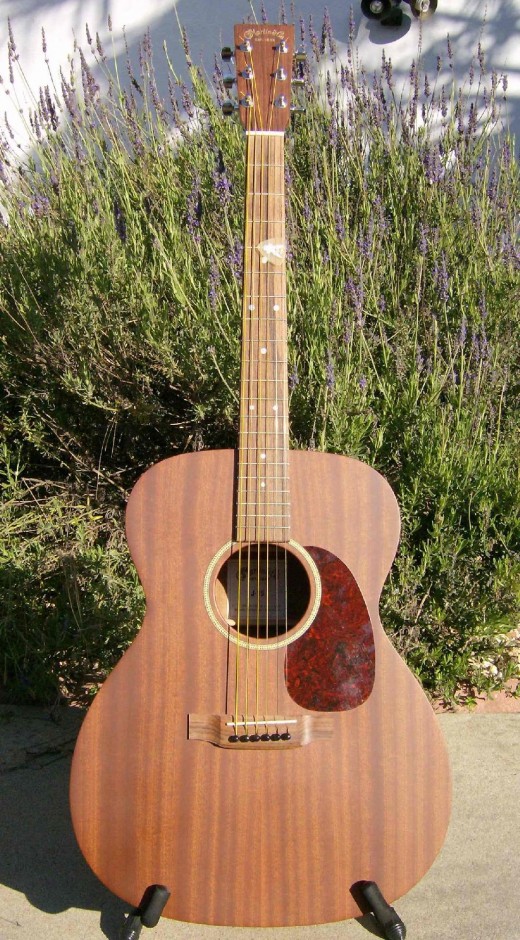
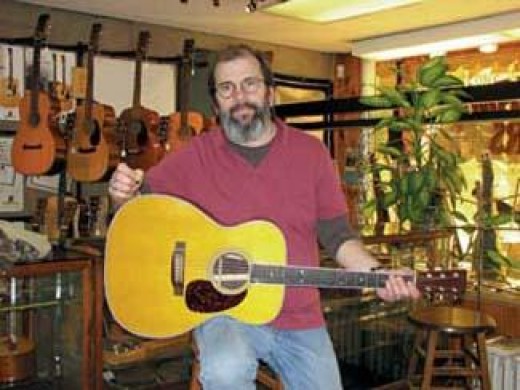
Mahogany is a much lighter weight wood than is rosewood, and this guitar is entirely of mahogany and/or it's very close cousin sapele, all throughout the body. Despite the larger than dreadnought sized body of this fine Jumbo sized acoustic guitar, it's not going to weigh a whole lot. Now mahogany when used in the body is well known to produce a lot of velocity of sound, but what about mahogany as a sound board on an all mahogany guitar like the J-15? Both Koa and mahogany have been used as soundboards or tops to fine acoustic instruments since the 1920's, and if you were to look at my thumbnail image here, you would see I am holding and playing an all mahogany Martin 00-17. Suffice it to say I know about all mahogany guitars, and how they differ from guitars with spruce tops. While mahogany bodies produce a high velocity of sound when compared to rosewood, mahogany tops or soundboards produce a much lower velocity of sound when compared to spruce tops or soundboards.
One could describe the tonality of a mahogany top guitar as subdued, dark, or rather suited to blues music. An all solid wood guitar from a master corporation like Martin is a work of art, and it should be used to further the artistic skills and endeavors of an artist, and this guitar will suit any professional or armature musician very well for all of his or her lives. These jumbo sized guitars being somewhat large, one should typically be certain such an instrument is suited for them, as being able to handle such a guitar could be an issue for someone on the small size of the physical spectrum. All Martin guitars come with a limited lifetime warranty to the original owner and a hard shell case. Thanks for reading.

The Takamine 40th Anniversary Guitar Featuring Persimmon As A Tonewood

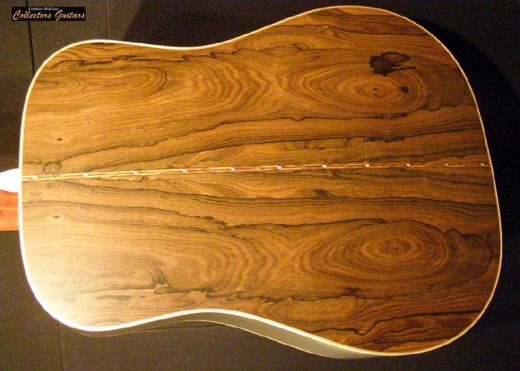
Persimmon wood backside of the Takamine 40th anniversary guitar

Takamine 40th Anniversary Dreadnought

Takamine instruments have been around for more than 40 years now. In fact, at this time Takamine's 50th anniversary model guitars are available, but looking through some old Acoustic Guitar magazines I found an article, a much shorter one than this will be, about the 40th anniversary Takamine guitar, and I was exceedingly intrigued by the facts of its construction.
Now I do a lot of writing about acoustic musical instruments on the web, and I mean on this site, and on a few others as well. Most often when I'm talking about a six string guitar in an online article, I know that instrument, I've sat in guitar shops and played that guitar, and so I can tell you I know what I'm talking about. I can not do that with this guitar, and probably very few people can. The Takamine 40th anniversary guitar resulted in the production of just 40 of these instruments. Very few people anywhere can tell you first hand about this guitar. What I want to talk about concerning the thing is how frigging unique a guitar it must be.
I don't know if too many peripheral six string fans have figured this out, or not, but the people who are rabid about guitars and guitar building are a pretty intellectual lot of folks. Building fine guitars is akin to being a sculpture in a way, except the guitars, the work of art they build, are then taken and used towards further works of art. Guitar builders are extremely interested in pieces of woods, taptones, and such; and what the combinations of woods and bracing they use to build a guitar is going to produce in the sonic sense.
While I'm not any sort of professional scholar in regards to acoustic instruments, I'm sure enough an amateur one. I don't have transportation just now, so I do not get to visit music shops so much, but I'd never before heard of a guitar besides this one having persimmon wood used for its back and sides. I brought the topic up to an uncle who used to sell guitars, and knows quite a lot about them, and he'd said himself he thought I must be mistaken, that there would be a great challenge in finding persimmon wood slabs big enough to make a dreadnought guitar, and this Takamine 40th anniversary instrument is certainly a dreadnought.

Persimmon Wood And Acoustic Guitar Building

Persimmon as a tonewood is uncommon, very uncommon. Using Google search I searched terms "dreadnought guitar with persimmon back and sides," and I found only two entries that looked decent at first glance. A man in Eastern Tennessee named Cliff Hamby[1] uses persimmon and other native trees to make hand made instruments, and another man named Bob Gramann[2], a newer builder. Persimmon wood is thought of as a native American ebony[3], and ebony, of course, has been used in acoustic instrument building for a very long time, and on the most expensive of instruments as the wood used for bridges and fretboards.
My search results linked above for "dreadnought guitar with persimmon back and sides" were essentially completely useless. Those builders in the first two references aren't using persimmon for back and sides, but for fretboards or bridges, or both. So I hope the reader can see how completely intriguing this Takamine instrument truly is.
This 40th Anniversary instrument from Takamine is a standard 14 frets clear of the body dreadnought. We've discussed the back and sides being persimmon, and the top is sitka spruce. The guitar features abalone inlay binding, an abalone rosette; and a 40th anniversary commemorative ruby. Fretboard markers are bow tie style. The instrument has a strange two piece style saddle which I'm not exactly sure how to name properly. Only 40 of these instruments were made, and when new, they sold for $4,000. I priced one today on the web for $2,000 used. This is an extremely rare "bird," and I wish I could find at least a youtube video about it, but alas, I can not. The persimmon wood looks a lot like Koa, and I can only wish to hear what these beauties sound like.

Steve Earle and the Martin M-21 Steve Earle Guitar

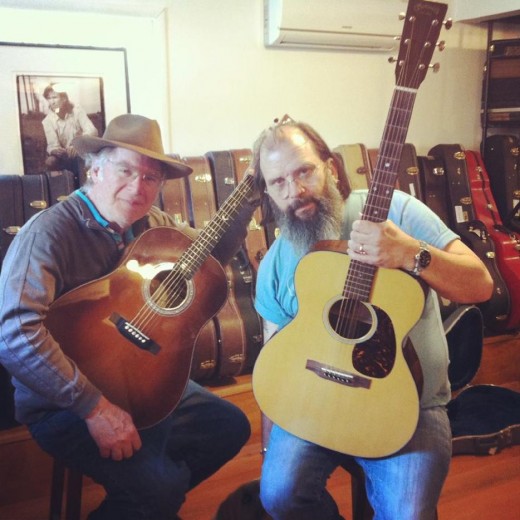
Steve Earle (right) With His Martin M-21 Guitar

Steve Earle

Steve Earle is an American singer, song writer, author, actor, and political activist. He's been a star, and he's been to prison, and then he's remade himself into a much better artist. Steve Earle, of course, is also a guitarist, and has always accompanied himself on records with one. Early in his career, Steve was more of a rockabilly sort of musician, and played electric guitars; but as he's gotten older, he's become devoted to acoustic instruments.
Born in Texas in 1955, Steve spent years in Nashville, Tennessee; and now resides in New York City. As for myself, I've always been a huge fan of Steve Earle, and what I have always appreciated was the way he's never been one to try to make "hits," he's a guy who has always had serious subject matter that was closest to his heart, and so pretty often, his songs are about controversial topics. The man, however, also has a serious sense of humor.
Steve Earle's music spans a lot of styles. Some of his music could nearly be considered "rock music," and other things were once country music radio staples. He's done albums that were straight Bluegrass music, and he's done a lot of things with some dark country music themes. He's lived a rough life, drugs and alcohol, seven marriages, prison.
Mostly, Steve Earle's albums have some of this, some of that, and some of the other all inside. My personal favorite is called Train a' Comin', as it features multi instrumentalist folk master, Norman Blake. I'm a huge fan of Steve's, but I have to admit that I've not read any of his books. I'll remedy that at some point in time should I get the chance.

Steve Earle with his signature series Martin

The Martin M-21 Steve Earle Signature Guitar

It's little wonder the world's most renowned guitar builders built a guitar for an American classic like Steve Earle. Steve Earle and Martin guitars go together live the proverbial peas and carrots. This is, however, not a guitar you will often see, and it is similar to the Martin D-18 Gordon Lightfoot in that it isn't in production any longer. None of this means, however, that a demand won't at some point or another reintroduce the guitar to standard production, and Steve is still around to sign them, and we hope he will be for a long time to come.
So what the heck is an M-21? I've never heard of anything like that?
Well, there's nothing really strange or odd about the "M" body style guitars by C.F. Martin & Company at all. These guitars are actually pretty popular, and a lot of renowned guitarists who aren't exactly famous, play them exclusively. People like David Bromberg come to mind here, as he also has his own "M" body design produced by Martin. The most common of the "M" body guitars is probably the Martin M-38, the David Bromberg guitar is an M-42.
Essentially, an "M" model acoustic guitar, is the same shape as is an OM, or "orchestra model," but the overall size of the "M" guitars is larger, despite being proportionally the same as OM's, just larger. Did that make any sense? I hope it did.
Whenever you are looking at, or reading about a Martin guitar, the number after the letter tells you how expensive the guitar is going to be. Why more expensive? Well, with Martin guitars, more expensive DOES NOT mean "better," it only means MORE EXPENSIVE. For these reasons, this Steve Earle signature guitar is going to be priced really well until its no longer in production status drives the market price for the thing upwards.

Earle model particulars

Don't let the enlarged OM or "orchestra model" design of these guitars fool you, these M body guitars are actually larger instruments than a Martin dreadnought, like a D-28. Like I'd stated before, Martin guitars aren't priced for their size, their price is generally indicated by the number following the letter. I'm pricing this instrument on the web for $4,299 dollars. It is a custom guitar, and they're all signed by Steve Earle; so this guitar is a bit more expensive than it otherwise would be.
The exact dimensions of this guitar are those of a 0000 body with a 000 body depth This is absolutely a "high X" guitar, which is to say it features forward shifted scalloped X bracing. All such instruments are fragile, but are built for someone desiring the best in sound the most known for it on the planet manufacturer can offer. When you buy something like this, you go in knowing you're purchasing a very precious and fragile thing that requires attention to care.
The back and sides are of East Indian rosewood, and the top is Alpine spruce. It is an entirely all solid wood guitar. The neck is carved from mahogany, and the fretboard and bridge are of East Indian rosewood as well. The rosette is style 18, but the backstrip is style 28. Waverly tuning machines can't be beaten, and those are what are used here. "Doppler Dot" fretboard position markers are used, and this is unique to Martin "21" style guitars. Martin's polished gloss lacquer finish is the standard everyone else is measured by; and it will shine for quite a long long while, showing off that top grade wood that produces such crystalline tonality.
All Martin guitars come with a full limited lifetime warranty to the original owner, and a deluxe hardshell case. Let's hear ol' Steve pick one, shall we?

Twitter Delicious Facebook Digg Stumbleupon Favorites More

 
Design by Free WordPress Themes | Bloggerized by Lasantha - Premium Blogger Themes | Laundry Detergent Coupons