Thursday, April 20, 2017

The Takamine 40th Anniversary Guitar Featuring Persimmon As A Tonewood

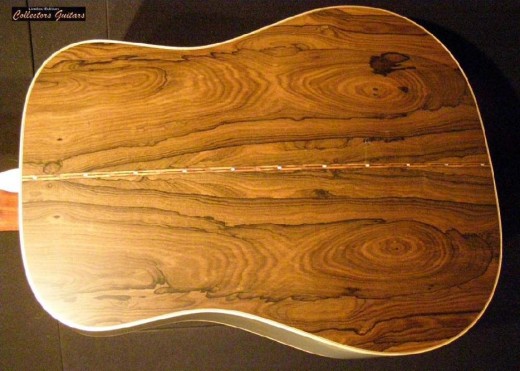
Persimmon wood backside of the Takamine 40th anniversary guitar
Takamine 40th Anniversary Dreadnought

Takamine instruments have been around for more than 40 years now. In fact, at this time Takamine's 50th anniversary model guitars are available, but looking through some old Acoustic Guitar magazines I found an article, a much shorter one than this will be, about the 40th anniversary Takamine guitar, and I was exceedingly intrigued by the facts of its construction.
Now I do a lot of writing about acoustic musical instruments on the web, and I mean on this site, and on a few others as well. Most often when I'm talking about a six string guitar in an online article, I know that instrument, I've sat in guitar shops and played that guitar, and so I can tell you I know what I'm talking about. I can not do that with this guitar, and probably very few people can. The Takamine 40th anniversary guitar resulted in the production of just 40 of these instruments. Very few people anywhere can tell you first hand about this guitar. What I want to talk about concerning the thing is how frigging unique a guitar it must be.
I don't know if too many peripheral six string fans have figured this out, or not, but the people who are rabid about guitars and guitar building are a pretty intellectual lot of folks. Building fine guitars is akin to being a sculpture in a way, except the guitars, the work of art they build, are then taken and used towards further works of art. Guitar builders are extremely interested in pieces of woods, taptones, and such; and what the combinations of woods and bracing they use to build a guitar is going to produce in the sonic sense.
While I'm not any sort of professional scholar in regards to acoustic instruments, I'm sure enough an amateur one. I don't have transportation just now, so I do not get to visit music shops so much, but I'd never before heard of a guitar besides this one having persimmon wood used for its back and sides. I brought the topic up to an uncle who used to sell guitars, and knows quite a lot about them, and he'd said himself he thought I must be mistaken, that there would be a great challenge in finding persimmon wood slabs big enough to make a dreadnought guitar, and this Takamine 40th anniversary instrument is certainly a dreadnought.

Persimmon Wood And Acoustic Guitar Building

Persimmon as a tonewood is uncommon, very uncommon. Using Google search I searched terms "dreadnought guitar with persimmon back and sides," and I found only two entries that looked decent at first glance. A man in Eastern Tennessee named Cliff Hamby[1] uses persimmon and other native trees to make hand made instruments, and another man named Bob Gramann[2], a newer builder. Persimmon wood is thought of as a native American ebony[3], and ebony, of course, has been used in acoustic instrument building for a very long time, and on the most expensive of instruments as the wood used for bridges and fretboards.
My search results linked above for "dreadnought guitar with persimmon back and sides" were essentially completely useless. Those builders in the first two references aren't using persimmon for back and sides, but for fretboards or bridges, or both. So I hope the reader can see how completely intriguing this Takamine instrument truly is.
This 40th Anniversary instrument from Takamine is a standard 14 frets clear of the body dreadnought. We've discussed the back and sides being persimmon, and the top is sitka spruce. The guitar features abalone inlay binding, an abalone rosette; and a 40th anniversary commemorative ruby. Fretboard markers are bow tie style. The instrument has a strange two piece style saddle which I'm not exactly sure how to name properly. Only 40 of these instruments were made, and when new, they sold for $4,000. I priced one today on the web for $2,000 used. This is an extremely rare "bird," and I wish I could find at least a youtube video about it, but alas, I can not. The persimmon wood looks a lot like Koa, and I can only wish to hear what these beauties sound like.

Steve Earle and the Martin M-21 Steve Earle Guitar

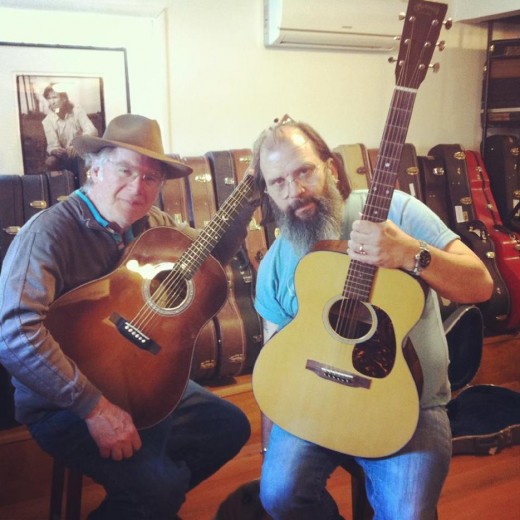
Steve Earle (right) With His Martin M-21 Guitar

Steve Earle

Steve Earle is an American singer, song writer, author, actor, and political activist. He's been a star, and he's been to prison, and then he's remade himself into a much better artist. Steve Earle, of course, is also a guitarist, and has always accompanied himself on records with one. Early in his career, Steve was more of a rockabilly sort of musician, and played electric guitars; but as he's gotten older, he's become devoted to acoustic instruments.
Born in Texas in 1955, Steve spent years in Nashville, Tennessee; and now resides in New York City. As for myself, I've always been a huge fan of Steve Earle, and what I have always appreciated was the way he's never been one to try to make "hits," he's a guy who has always had serious subject matter that was closest to his heart, and so pretty often, his songs are about controversial topics. The man, however, also has a serious sense of humor.
Steve Earle's music spans a lot of styles. Some of his music could nearly be considered "rock music," and other things were once country music radio staples. He's done albums that were straight Bluegrass music, and he's done a lot of things with some dark country music themes. He's lived a rough life, drugs and alcohol, seven marriages, prison.
Mostly, Steve Earle's albums have some of this, some of that, and some of the other all inside. My personal favorite is called Train a' Comin', as it features multi instrumentalist folk master, Norman Blake. I'm a huge fan of Steve's, but I have to admit that I've not read any of his books. I'll remedy that at some point in time should I get the chance.

Steve Earle with his signature series Martin

The Martin M-21 Steve Earle Signature Guitar

It's little wonder the world's most renowned guitar builders built a guitar for an American classic like Steve Earle. Steve Earle and Martin guitars go together live the proverbial peas and carrots. This is, however, not a guitar you will often see, and it is similar to the Martin D-18 Gordon Lightfoot in that it isn't in production any longer. None of this means, however, that a demand won't at some point or another reintroduce the guitar to standard production, and Steve is still around to sign them, and we hope he will be for a long time to come.
So what the heck is an M-21? I've never heard of anything like that?
Well, there's nothing really strange or odd about the "M" body style guitars by C.F. Martin & Company at all. These guitars are actually pretty popular, and a lot of renowned guitarists who aren't exactly famous, play them exclusively. People like David Bromberg come to mind here, as he also has his own "M" body design produced by Martin. The most common of the "M" body guitars is probably the Martin M-38, the David Bromberg guitar is an M-42.
Essentially, an "M" model acoustic guitar, is the same shape as is an OM, or "orchestra model," but the overall size of the "M" guitars is larger, despite being proportionally the same as OM's, just larger. Did that make any sense? I hope it did.
Whenever you are looking at, or reading about a Martin guitar, the number after the letter tells you how expensive the guitar is going to be. Why more expensive? Well, with Martin guitars, more expensive DOES NOT mean "better," it only means MORE EXPENSIVE. For these reasons, this Steve Earle signature guitar is going to be priced really well until its no longer in production status drives the market price for the thing upwards.

Earle model particulars

Don't let the enlarged OM or "orchestra model" design of these guitars fool you, these M body guitars are actually larger instruments than a Martin dreadnought, like a D-28. Like I'd stated before, Martin guitars aren't priced for their size, their price is generally indicated by the number following the letter. I'm pricing this instrument on the web for $4,299 dollars. It is a custom guitar, and they're all signed by Steve Earle; so this guitar is a bit more expensive than it otherwise would be.
The exact dimensions of this guitar are those of a 0000 body with a 000 body depth This is absolutely a "high X" guitar, which is to say it features forward shifted scalloped X bracing. All such instruments are fragile, but are built for someone desiring the best in sound the most known for it on the planet manufacturer can offer. When you buy something like this, you go in knowing you're purchasing a very precious and fragile thing that requires attention to care.
The back and sides are of East Indian rosewood, and the top is Alpine spruce. It is an entirely all solid wood guitar. The neck is carved from mahogany, and the fretboard and bridge are of East Indian rosewood as well. The rosette is style 18, but the backstrip is style 28. Waverly tuning machines can't be beaten, and those are what are used here. "Doppler Dot" fretboard position markers are used, and this is unique to Martin "21" style guitars. Martin's polished gloss lacquer finish is the standard everyone else is measured by; and it will shine for quite a long long while, showing off that top grade wood that produces such crystalline tonality.
All Martin guitars come with a full limited lifetime warranty to the original owner, and a deluxe hardshell case. Let's hear ol' Steve pick one, shall we?

The New Gibson J-35

The Gibson J-35

Brand New Re-introduced Gibson J-35

Right here and right now is the golden age of guitar building in the world. There has never been a better time to buy a guitar. Oh sure, Martin guitars and Gibson guitars both refer to the pre world war two era of guitar building as the "golden era," but facts are, we've better technology and much better understanding of how to build a great acoustic guitar right here, and right now. Yes, some of the great tonewoods are now very hard to get, but others are not; and still new tonewoods are being used to terrific effect.
Gibson guitars was established in the USA in the year 1902, and since that time they've done a great job at rivaling C.F. Martin & Company for preeminence in guitar building in the USA. Martin developed its dreadnought body style in 1931, and Gibson promptly came out with its own version of that size guitar, and the J-35 is just that. Oh the "J" stands for "jumbo," but the guitar is a dreadnought, and there is no doubt about that. Gibson's design simply has slightly different dimensions, and a more rounded, or sloped set of "shoulders" on it.
Gibson may compete directly with Martin in global acoustic guitar sales, but there are things to know about this. The guitars by Gibson and Martin sound completely different. You can get a Martin D-18, and this Gibson J-35 and play them one after the other, and you'll see, they don't really sound alike at all, and this is due to the way they are braced, and because of many another nuance of guitar building as well.
Now the Gibson J-35 is a standard fourteen frets clear of the body all solid wood steel string instrument. It's made from solid mahogany on the backs and sides, and features a solid spruce top as well. The J-35 is a very low priced instrument for an all solid wood Gibson flat top, and in the case of this one, it is also equipped with pre-amp and a pickup for acoustic electric play. This instrument is ideal for either playing in a studio, with your musician friends, or on a stage; it's a do it all guitar.
This is a mahogany body guitar; and so it will have a very decidedly mahogany sound, and that means it will have a very bright, and immediate tonality. Mahogany is relatively inexpensive compared to rosewood, but it provides an extremely high value, and a completely different sound. Mahogany is absolutely preferred OVER rosewood, or anything else for that matter, by a large number of musicians. So the Gibson J-35 is a relatively similar instrument to something like the Tacoma Road King, but it costs more than twice as much; well, the big thing about that is, it says GIBSON on it, because that is what it is. Whenever you have a guitar made by premium manufacturers like Gibson or Martin, you've got something that will appreciate in value over time, or at least keep its value should it get scuffed up a bit.
There are qute a lot of guitars on the market that are also steel string dreadnoughts with mahogany and spruce, and fourteen frets clear of the body, and equipped for acoustic/electric play. One in particular that I'm fond of, and that competes very nicely with the J-35 in price and in specifications is the Guild D-40.
The J-35 does have a lot of rosewood on it. The fretboard or fingerboard is rosewood, and so is the bridge. Essentially, the J-35 is a J-45 with just a bit less ornamentation so as to be more affordable. The electronics on the guitar are all by L.R. Baggs; and can be expected to produce exactly as anyone would want them to. The Mahogany neck, as are all Gibson necks, really feel wonderful, and allow for your playing to be as effortless as it can be. It measures at 1 and 3/4" at the nut; and speaking of the nut, both the nut and saddle are made from tusq material, so that every note is loud, clear, and rings out with long lasting sustain. The fire stripped pick guard is unique to this instrument, and really allows one to see what model guitar is being played; it's really attractive. This guitar was in production years and years ago, but is now being re-introduced by Gibson for 2013, and it sure does look and sound like an all around winner. Of course a beautiful hardshell case is included, as is Gibson's Gold warranty.
This is a guitar to be excited about. If you're shopping for a great priced heirloom quality professional instrument, be sure you check one of these out before buying another. Thank you for reading.

Gibson J-35 backside

Seagull Maritime SWS Dreadnought Guitar

The Seagull Maritime SWS Guitar

Solid Wood Series Seagull Guitars

Making music is an exciting thing. Learning to make music is even more exciting, and when you're learning guitar, you generally start off on a low end acoustic guitar that doesn't always sound so good. If you make progress, and keep the faith that you can make good music on a guitar, and also keep the interest, then another exciting thing will likely occur for you, and that exciting thing is that at some point in time, you'll bother to own a truly professional grade instrument.
The Seagull instrument discussed here is a truly professional grade instrument, and one can be had at what is a supremely reasonable price. We're talking about an all solid wood guitar here; in fact, the "SWS" stands for "solid wood series." For less than a thousand US dollars, anyone can own the Seagull Maritime SWS acoustic guitar, and they'll then own a guitar that will provide professional level services to them the rest of their lives, so long as they take good care of it. Oh it matters none at all whether that person go on to become some sort of musical star, the Seagull Maritime SWS surely doesn't care, it merely provides, and keeps providing, until many a lifetime is over and done with, provided that it is cared for.
In the past, the young music enthusiast had no such opportunity as one has today. No solid wood instruments were available at a reasonable price, unless someone happened into a beaten up a bit one somewhere on the used market. It used to be that a picker had to go from a five hundred dollar Yamaha all the way to a twenty five hundred dollar Martin. Seagull guitars has done truly terrific things, as have others, with modern building technology, and they've made it to where a truly front line, totally professional level instrument can be had for less than a thousand dollars.

All Solid Wood, and The Beautiful Sound Of Mahogany For Less Than A Thousand Dollars

Friends, when you get into acoustic guitars they come in three varieties of value: 1. made entirely from laminated wood, 2. with a solid wood top, and 3. guitars made entirely of solid wood. It shouldn't be hard for you to figure that all laminate guitars are cheap, inexpensive, and don't have much value. Next up, are guitars with solid tops, and generally it is a very low grade, but solid spruce top, and then you have truly wonderful guitars, guitars made from solid pieces of wood, from the body, the top, the neck, and the headstock. The Seagull Maritime SWS is just such a guitar, it is an instrument built with ALL solid woods, and this maximizes the tonality of the instrument, and it also means the thing can take a bit more abuse than can a cheaper guitar, and it will still rock on steady as she goes.
What makes this guitar so great?
If you're really slow, I'll state it for you again, this guitar is all solid wood, and that means it will sound like a total canon. An all solid wood guitar is quite a lot larger with the tonality than is a guitar with laminates involved in it, and this guitar happens to be mahogany, and mahogany is in and of itself a wood that produces a much more immediate tonality. If you're into physics, you could rightly say that mahogany guitars produce a greater velocity of tonality. Mahogany is a nice old hardwood, and it is used far and wide, but nowhere is it used towards a greater thing than in musical instruments. The abundance of mahogany make it tremendously valuable in that it is inexpensive when compared to comparable tonewoods. This guitar by Seagull is priced at less than one thousand dollars, and though it is very traditional in design, one might want to compare it to another great solid wood mahogany body guitar, the Tacoma RoadKing
The SWS series guitars by Seagull DO include more expensive rosewood body models, so when shopping, be certain you realize the scarcity of rosewood makes for a much more expensive guitar, but not a better guitar. Rosewood and mahogany offer VERY different tonal properties. The prospective buyer should DEFINITELY be familiar with the difference so as to make an informed choice as to what kind of guitar tone they wish to have presented from their playing.
Seagull Maritime SWS guitars are not limited to a dreadnought body size, but are also available in jumbo sizes, and smaller than standard "folk" model sizes. These guitars are Canadian made, and they are priced to compete VERY favorably with US made guitars on the same level. Truly, these instruments out of Canada are terrific, and in time as great tonewoods are depleted, prices will rise. If you're looking for an instrument that can last you a lifetime and will do you justice around the campfire or in a recording studio, check out these Seagull solid wood series guitars today.

The Martin D-28 Marquis

Jimmy Page and His Martin D-28 Marquis

C.F. Martin & Company, and The D-28 Dreadnought Guitar

When it comes to steel string acoustic guitars there is no doubt at all who makes the world's most noted and desired model; it is without doubt the Martin D-28. C.F. Martin & Company have been making guitars in the USA since 1833. They are one of the USA's oldest and proudest builders of anything, and luckily for folks like me and you, it is guitars they build. It was nearly one hundred years after Martin started manufacturing guitars that it landed on a design that would become not just its best seller, but the world's best selling design of acoustic guitar, the fourteen frets clear of the body "dreadnought" design.
Now C.F. Martin & Company makes many steel string acoustic guitars that are dreadnought bodies with fourteen frets clear of the body; but of all of them, the D-28 is the guitar that is most often seen, heard, purchased, and well, modified. There are quite a lot of variations of the D-28 produced both now, and in the past by Martin guitars; and the D-28 Marquis is another one of them. Having looked over the specifications of this D-28 design, I'm willing to bet this guitar is going to be one to convince many a man and woman to save his or her pennies, and to save his or her dimes.

East Indian Rosewood Is NOT An Inferior Tone-Wood

As you can see, the Martin D-28 Marquis is anything but cheap, or inexpensive. This is a very serious guitar, and it was made by very serious craftsmen and craftswomen. The people at C.F. Martin & Company only have the world's best reputation in acoustic guitars to defend, and they do defend their reputations very well. Sure, there are smaller manufacturers who produce virtually identical instruments to this one; but the truth is, those will cost more than this one, as Martin can afford to sell such an instrument at a lower price.
The Martin D-28 has always and will always be a rosewood body instrument with a spruce top, and if it says "D-28" on the thing, then it will always be an all solid wood instrument, a professional level instrument. Every D-28 ever made has been a guitar that would last a lifetime, or several lifetimes, if cared for properly. Originally, all Martin D-28 guitars were made from Brazilian rosewood, and Adirondack spruce, for sides and backs, and tops, respectively. As years went by, those specific woods became more and more scarce, and Brazilian rosewood was never an easy wood to work with anyway. Eventually Martin guitars moved to using East Indian rosewood for the backs and sides, and Sitka spruce for the tops of the D-28s, and other D-28 "like" instruments such as the D-35, and the D-45.
I've had some somewhat serious debates on the internet concerning what is "better," or "worse" in tonewoods such as Brazilian rosewood and East Indian rosewood. I've been told I was just plain wrong before, and even that I don't know what I'm talking about. But I assure you I do know what I'm talking about, and that is this: East Indian rosewood isn't a lesser wood than Brazilian rosewood at all, it is just a different wood, and it produces an ever so slightly different sound, while also having a different appearance than its Brazilian rosewood cousin. I've owned a Martin HD-28VR which featured East Indian rosewood, and I own a Santa Cruz dreadnought with Brazilian rosewood; and I've sat and played thousands of guitars over the years. What this Martin Marquis D-28 is, is a D-28 GE, but with East Indian rosewood instead of Brazilian rosewood; and this provides an instrument of very very similar tonal and visual properties for five thousand dollars less.
Dear readers, I can assure you that Brazilian rosewood is beautiful, I assure you that its tonal qualities are very complex, and beautiful. I can also assure you that inexplicably, any acoustic guitar featuring aBrazilian rosewood body is likely to develop hairline cracks in it, despite how well you've taken care of the thing. I can also assure you that for five grand less, the D-28 Marquis isn't a lesser instrument than the D-28GE.

The Martin D-28 Marquis With Sunburst Finish

Specifications

So there you have it, the only difference between the D-28 Marquis and the D-28GE is the species of rosewood used for the backs and sides of the body of the instruments. Let's not forget the five thousand dollars in price difference, that's definitely something to take note of. I suppose, however, that this is still insufficient. One might think the D-28 Marquis to not have anything different about it from the HD-28V, or HD-28VR, and this would be completely inaccurate.
The "GE" in the D-28GE stands for "golden era," and when we say something about a golden era and Martin acoustic guitars, we're talking about one thing, and one thing only; the major models of acoustic guitars Martin was building and selling in the years just prior to world war two. In both the D-18 and the D-28, and all other spruce top models from this time, Martin used Adirondack spruce for the tops, and the braces inside the body of the guitars. So the Marquis instrument is built in this way. Adirondack spruce is said to produce a louder, and clearer tonality than does Sitka spruce, and it is lighter, and stiffer. Generally speaking, when you purchase a guitar with an Adirondack spruce top instead of one with a Sitka spruce top, you can look to spending another one thousand dollars for that upgrade in woods.
There are more differences. The Marquis model D-28, as all Golden Era style martin dreadnoughts, will have a slightly wider neck. The neck on this instrument measures at 1 and 3/4 inches width at the nut. Some people will prefer this neck width, others will not. I think it is very important that someone play ANY guitar in a store before ever purchasing one.
As is standard, the fretboard is black ebony, as is the bridge, mahogany blocks and dovetail neck joints are used, the traditional high X bracing is employed, and the thing comes with limited lifetime warranty to the original owner, and a deluxe hardshell case.
Other perks include fossilized ivory nut, saddle, and bridge pins. Electronics are NOT available for this model of guitar. This is an acoustic picker's dream guitar; it's not something one would typically use in a live performance. This is a guitar too precious to often take on the road.

Twitter Delicious Facebook Digg Stumbleupon Favorites More

 
Design by Free WordPress Themes | Bloggerized by Lasantha - Premium Blogger Themes | Laundry Detergent Coupons