Thursday, April 20, 2017

Flatpicking Master Tony Rice

Tony Rice And His Famous 1935 Martin D-28 Guitar

Tony Rice, Clarence White, And That Famous D-28 Guitar

In the world at large, there is a serious lack of musical integrity. There are manufactured "stars" who can't play any sort of instrument, only sing songs written by corporate music execs for them to sing; and only do that while looking lascivious for the camera. Oh I could name dozens of the sorts of pop stars I'm thinking of, and you could too. Luckily for humanity's future, only the era of throw away stars and throw away pop will be remembered, as most corporate consumer music is single use and discard except in the instances of trivia.
If one ventures any distance from corporate radio and intentional dimwit drivel which never ceases emanating from a television set, then one might by chance encounter serious music, the kind of music one makes because they desperately love music, and seemingly must make music as their core inner being demands it of them. Guitarist David Anthony (Tony) Rice is that sort of musician. Tony Rice can't be said to be a household name; and it is probably true that the average metal or rock guitarist isn't familiar with Tony's music at all; but Tony Rice is to flatpicking guitarists something like what Tiger Woods is to modern golfers.
Tony was born the 8th day of June in the year 1951, in Danville, Virginia; but he spent his childhood in Los Angeles, California. Tony's father had been a semi-professional Bluegrass musician, and had spent considerable time teaching his interested sons about music, and musicianship. While in California the Rice family was able to run in the same circles as other prominent acoustic musicians. Tony would meet and befriend Clarence White, a brilliant guitarist of both bluegrass and rock and roll music, who'd die tragically young.
That Clarence White had a big influence on Tony Rice and his music goes without question. It's not mere chance that Tony owns Clarence's old 1935 Martin D-28 guitar; and it's no surprise that several of the best guitar manufacturers in the USA make their own very expensive reproductions of the specific and heavily modified D-28 guitar in question. The reproductions of the guitar are sometimes known as Tony Rice models, and sometimes known as Clarence White models. Tony's famous guitar might be the single most desired acoustic instrument in the world that isn't a Stradivarius violin.
Some might call it heresy. Some might suffer for having their notions squashed. Others will rejoice. The facts of the matter are that in more recent years, Tony Rice has come to prefer one specific guitar made for him over the legendary Martin instrument[1]. Of course it is one of the several Tony Rice Professional models designed for him by the Santa Cruz Guitar Company, and designed to be as similar to the Martin instrument (the 1935 D-28 which used to belong to Clarence White is heavily modified) as possible. It was bound to happen, of course, after many years of back and forth with the luthiers at the SCGC, they were bound to eventually come up with an instrument Tony would prefer to one he'd played seemingly without ceasing over the years.

David Grisman, Tony Rice, and Jerry Garcia

The Music Of Tony Rice

Bluegrass music was originally just traditional Scot or Irish fiddle tune style music, and incorporating a five string banjo, and some high tenor vocals along with rhythm guitar, mandolin, fiddle, and a big stand up acoustic bass. The guitar wasn't much thought of as anything but a rhythm instrument in the context of trans-Atlantic fiddle music in Appalachia. Over time what was known as "G runs," and other bits of licks were incorporated into the music provided by the guitarist, and nowadays if you hear one, it sounds very cliché.
Don't get me wrong here, playing great rhythm guitar, and keeping in time with some banjo or fiddle, or mandolin guy with an adrenalin rush at super fast tempos isn't easy; but originally that was all the guitars were used for in folk, Celtic, bluegrass, and country music. Doc Watson, the legendary blind guitarist from North Carolina was the person most responsible for taking the big dreadnought guitar, and deciding to use the thing for something other than just playing rhythm, or fingerpicking some country blues. While Tony Rice being compared to Clarence White is natural; it's also well to note here that Tony Rice, like Doc Watson, is a guy who had a triple attack, he could sing, and he could play with the best of the best in the fields of lead, or soloing, and rhythm too. Had? Well, probably anyone who's made it this far in this piece already knows; Tony Rice can no longer sing due to some injury to his vocal cords.
In 1974 Tony Rice joined J.D. Crow & The New South, as guitarist and lead vocalist, and the band recorded the album with the band's name as its title. While J.D. Crow's band always featured some of the best and brightest musicians in the Bluegrass genre, this particular lineup was special for also featuring Ricky Skaggs on mandolin. The album, produced by Rounder Records, would become the best selling item they'd ever had. Tony Rice brought not just his terrific guitar skills, but his unique and beautiful vocals to the mix. While the album could mostly be considered "traditional," it was also truly "progressive" in that Tony didn't pursue the "high lonesome" vocal stylings of people such as Bill Monroe, Ralph Stanley, or Jimmy Martin.
Bluegrass music is absolutely unique to the United States of America. It's a form of music based on fiddle tunes from the British Isles, but the instrumentation, and now most of the music itself; are uniquely American. Of course Bluegrass music is appreciated and played all over the world; and though Tony Rice has dedicated a large portion of his adulthood and career to traditional Bluegrass music, he's also spent as much or more time expanding it, and breaking from it altogether.

Playing Style

Of course Tony Rice can play very very fast. That's hardly what makes him such a special guitarist. Playing Bluegrass instrumentals with mandolin, fiddle, or banjo players is forever going to be a very strenuous thing for the flatpicking guitarist; as the guitar has a wider neck, and six strings to move across in hopes of maintaining the tempo. I should lay out right here for anyone who might have not realized it, playing fast on a steel string acoustic guitar strung with medium gauge strings is far far harder than it is playing at the same speed on a Stratocaster or something.
Tony Rice's guitar playing, insofar as one can tell, is flawless. You simply never hear him make a mistake, and every single note is loud, clear, and has such a beautiful, bell like tone-that it is hard to imagine how someone could ever execute such things so cleanly. What he does, and the reason he's so often thought of as the logical continuation of Clarence White; is he plays really wild, unexpected things, and he manipulates time in the context of any tune with complex syncopation.
Tony went from the J.D. Crow band to doing solo work with the very best side-men in the genre; and he expanded what was thought of as Bluegrass, or folk music by often covering tunes by artists outside of Bluegrass. Persons such as Gordon Lightfoot, Bob Dylan, and James Taylor come to mind. Collaborations with Norman Blake were treasured by guitarists. Tony has recorded solo albums, many albums with The Bluegrass Album Band, albums with The Tony Rice Unit, and of course, the albums with the David Grisman Quintet.
When I was younger, and even now whenever I'd get into playing my guitars regularly, I would think of this guy as the absolute "god" of playing an acoustic guitar with a pick. Oh Tony Rice isn't truly famous. I'd say most people who dabble with guitar don't even know who he is. It's no fault, but a credit to Tony he's forever taken his talents and used them purely to do what he's wanted to do, and not into the so typical notion that "making the most money possible is the best possible thing."
When Tony Rice met David Grisman in the 1970's, a new and American form of music became more attractive, and better. Some call it "Dawg" music, as Dawg is Grisman's nickname, others called it "spacegrass." What it is, is jazz played on bluegrass instrumentation. This form of music isn't commercial, and it isn't something one expects to become "popular." It is intellectual music somewhat reminiscent of the music of Django Reinhardt, and The Hot Club of France. Grisman and Rice mirrored Reinhardt and Grappelli in a way.
In his years of being a dedicated musician, Tony Rice has developed a rare thing, he's instantly recognizable when you hear him, and totally unique. I'll be very interested to hear what he plays in the future; as he does nothing unless it is done to the highest standards. Thanks for reading.

The Martin HD-35

Martin HD35

Martin D 35 Three Piece Rosewood Back

This guitar is a Herringbone Dreadnought With 35 appointments

C.F. Martin & Company's D 28 guitar was originally a herringbone dreadnought, but over time Martin decided to make those rosewood and spruce dreadnoughts without the specifications and trim that had caused them to sometimes simply be called herringbones. When due to high demand Martin had to once again start making the much more fragile designs of the D 28 that it had become famous for making before and during world war two, Martin had started calling those special instruments HD 28's.
The H stands for herringbone, and the D stands for dreadnought.
First and foremost it's important to realize that essentially the Martin D 28 and the Martin D35 are both dreadnought guitars of exactly the same size and shape that are both completely solid wood constructed instruments with rosewood back and sides and a spruce top. Both are 14 frets clear of the body, and designed to be either fingerpicked or flatpicked with steel strings on them.
The chief difference is that the D-35 has always had a fancy three piece back that looks really cool. The thing is, nobody ever sees the back side of it if it's being played, and being played is the thing that a guitar was created to do.

Guitars were created for SOUND and Play-ability

Who can against the idea that guitars were created to be played?
Guitars were most definitely created to be played and heard, and that is why the herringbone Martin D 28 became the most famous, copied, and sought after acoustic guitar in the world. The herringbone D 28 just sounded so much better than any other instrument except for maybe the D18.
Why did these guitars sound so great? Well, it wasn't the "magic" combination of rosewood and spruce that made the D 28 sound so great, if that were it, then the D35 would have sounded just as good, and there would be no reason to ever create the HD35. The HD 35 is essentially just a pre war construction or recreation of the D28's of old or vintage recreation, but with a three piece back of the D 35.
What is essential to understand with the prefix H or the fact of herringbone trim on a Martin guitar is that by having herringbone trim, the trim also signifies things that can NOT be seen from the outside of the instrument. The herringbone trim of the HD 28 or the HD 35 also signifies that the guitar is a high X construction instrument - in regards to the internal bracing of the guitar, and that the braces are scalloped.
When your guitar is a high X Martin then you've got scalloped bracing. You can have scalloped bracing on a Martin instrument without herringbone trim - and such is the case in instruments like the D18.
High X bracing, scalloped bracing - these things make a guitar fragile, but sound far more wonderful than it otherwise would, with far more sustain and volume. Thus, the HD 35

The Martin D 18 Gordon Lightfoot Guitar, The D 18GL

Martin D-18GL

Martin and The Gordon Lightfoot D 18 The High Class Mahogany Dreadnought.

Through the years, and specifically concerning the making of acoustic steel string guitars, rosewood instruments have always been adorned with much greater levels of care, material, and detail than have mahogany instruments. Rosewood instruments take more time and effort to shape into guitars to begin with, while mahogany is much easier to work with. For these reasons people have always just sold mahogany guitars for less money than they have their rosewood body models.
Also, they surely figure that since they are already spending so much time to shape the wood into the shape of a dreadnought body guitar, why not just go all out and fit in, cut, design, and shape about a thousand little pieces of abalone inlay while we're at it? That is obviously the thought process, as when one sees the amazing and extraneous levels of abalone inlay featured in guitars such as the Martin D 100 - and realize that it's price is the same one hundred in the proverbial K denomination...You wonder, naturally, why instruments such as the Martin D 18GL havent taken over the entire market for the sheer beauty they have with so much less in the way of market price.
The Limited edition and hard to find Martin D 18GL is one of the most beautiful mahogany body dreadnought guitars that you'll ever encounter, presuming that you are, in fact, lucky enough to encounter one. The Gibson Hummingbird guitar would be comparable so far as having a mahogany body and a lot of abalone inlay is concerned. The thing about the Gibson, however, is that it's just NOT a Martin, and doesn't have the legendary Martin sound. If the Gibson sound is preferable to your style of music, and to lots of persons it is, then please go for the amazing Gibson Hummingbird. Lots of folks, however, have always dreamed of a dressed up Martin D 18, and this is it.
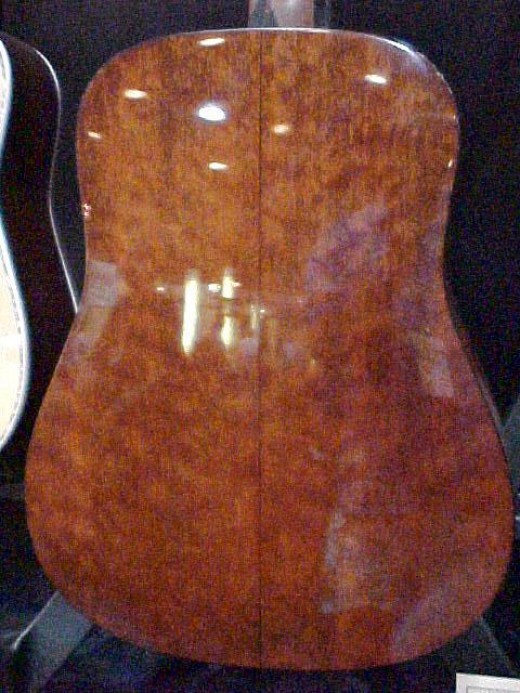
The Martin D 18GL is certainly dressed up, and the biggest visual attraction of this instrument isn't even the additional abalone inlay work, it's the quilted mahogany body of the instrument. Of course all solid wood construction was used, and besides the quilting of the mahogany, an Englemann Spruce soundboard was used rather than Sitka. The guitar could be compared to the Martin D18 GE, but it's really a different instrument due to the quilting, the Englemann spruce instead of red Adirondack spruce, and also, the size of the neck at the nut is different. The Golden Era Martin is 1 3/4" at the bone nut, while this guitar is 1 11/16" at the nut.
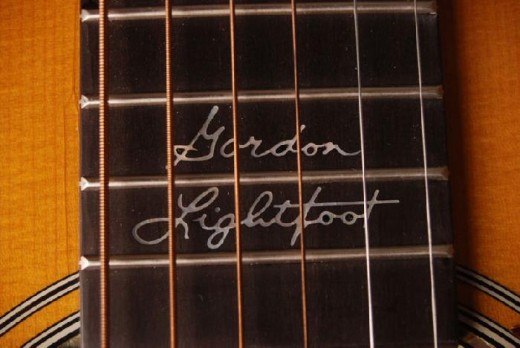
Gordon Lightfoot's signature is inlaid in pearl at the 19th fret, and quite a lot of abalone inlay work around the rosette make this instrument a super collectors item and a player's dream come true.
This is not a production instrument, and so the list price is irrelevant, these guitars in excellent to mint condition are going for around $5,000.00

Quilt mahogany back side and Gordon Lightfoot signature inlay

Alternative Tonewoods For Acoustic Guitar

Ovangkol

Traditional and Non Traditional Tone Woods For Acoustic Guitars

Basically, nearly all modern acoustic guitars are based on designs made by either the C.F. Martin & Co or the Gibson Guitar Company prior to the second world war. Those guitars are still out there, and they sell at astronomical prices as they are considered the HOLY GRAIL guitars that only the very wealthy, or the very lucky own. It's true that many of those guitars, and especially the Martin guitars, are amazing instruments that resonate such complex and beautiful tones that it's tough to imagine better instruments.
GET OVER IT.
It's rather foolish to think that nothing has been learned or improved upon in guitar building. Every manufacturer in the industrialized world has looked over those instruments or their designs, and found a way to tweak them to their on specifications and desired qualities. Right here and right now is the true Golden Age of guitar building. The finest instruments in the world are on sale right here and right now in modern America.
Now truly, guitars made with Brazilian Rosewood back and sides are both physically beautiful to the eye and also embody a truly mysterious sound full of unique overtones that no other wood can seem to replicate. . .but that doesn't mean that other woods don't have equally unique and beautiful properties. Brazilian Rosewood has been overly abused as a wood for musical instruments and other things. We've other beautiful tones to explore now - but if you've got the money, then go right ahead and buy yourself either a brand new or a used guitar with solid Brazilian Rosewood backs and sides - keep it, treasure it - it's a treasure.
East Indian Rosewood, however, is not a inferior wood, but only a different wood - and no two guitars are ever equal even when made from the same trees by the same builder to the exact same specifications - they are still going to be unique, and have characteristics that are their own.
Adirondack Spruce was the typical sound board tone wood used in conjunction with Brazilian Rosewood on the Holy Grail Martin and Gibson guitars - but like Brazilian Rosewood, Adirondack Spruce is now far too over used, and the forests have not replenished themselves. How can forests ever replenish themselves in a world of capitalist consumerism greed? They can NOT, I tell you - and probably the will not.
Sitka Spruce is now used on most good acoustic guitars. A spruce sound board's quality is NOT found in the tree that it came from, and never really was - and truly, not everyone prefers Adirondack Red Spruce or even German Silver Spruce. Sitka Spruce is a fine tone wood. I'm truly an acoustic guitar snob - but I'm not a tone wood snob. I'm open to new woods and new sounds. I think everyone should be.
Now days things are changing, and woods like Sitka Spruce and East Indian Rosewood are no longer considered as alternative tone woods, but are now standard tone woods. Builders and players of fine acoustic guitars, however, must not stop there - but go beyond rosewood, spruce, mahogany, and maple. There's tons of other good species of tree out there for both body and tops on acoustic guitars. We must be not driven by capitalist foolishness, but rather, the desire to preserve things for the future.

So what are the NEW Alternative Tone Woods Used For Building Acoustic Guitars?

There are many different new tone woods being used by many different guitar builders for all parts of guitar building, including back and sides, necks, sound boards, and fret boards. The only thing sad at all about any of this is that good Brazilian Rosewood is still not available, and probably won't be ever again. These new tone woods, however, should be given a chance. The reason why the pre world war two era Martin and Gibson guitars sound so good - has more to do with how old those guitars are, and you have to realize that the wood that was used to build those guitars may have already been many years old before they were built.
What I mean by "old" is that the wood used to build the legendary pre war guitars could very well have been sitting in the warehouse on shelves at Gibson and Martin for any number of years.
What most often makes a guitar sound great besides it's construction and the type of woods used is how loudly and often it's been played. Someone using a heavy pick and a heavy attack can and will break in a guitar much quicker and much more thoroughly than will someone who plays with a meek and thin plectrum, or who finger picks. Wood has to vibrate and breathe to reach it's sonic potential.
A solid wood sound board is the first upgrade between an all laminate Wal-mart special, and a real guitar - and mostly one form of spruce or another is used, but there are also all mahogany guitars, and they have a nice warm sound to them - but less volume without amplification. But also more and more Western Red Cedar is used for the sound boards of fine acoustic guitars. One of my uncles has a Yamaki, a fairly rare Japanese built guitar of very good quality, and it has a Western Red Cedar Top for it's sound board. Western Red Cedar is said to have a more "open and broke in" sound to it than does spruce - in other words, it sounds like an older guitar right out of the box should a guitar have Western Red Cedar as it's sound board. The one complaint about the wood is that it can be "overdriven" by a heavy pick attack, and that notes can become distorted in that way. I've just not seen that happen, as I've tried to see and hear that for myself on a number of guitars that I've picked a tune out on having Western Red Cedar tops.
Redwood is another tone wood being used for sound boards these days. I personally have not played a guitar with a Redwood sound board. I believe that most often these types of sound boards are found on classical guitars, and I'm more of a steel string guitar fan. I'm told that Redwood , somehow, offers greater note to note clarity than does other tone woods for sound boards - but I'm also told that it's a lighter and more delicate wood.

New Tone Woods For Acoustic Guitar Bodies

Claro Walnut is an exceedingly beautiful wood that is being used by some manufacturers for acoustic guitar backs and sides, this wood is deep and dark brown, and sometimes has some very attractive wave or flame type grain to it. Walnut is said to have the "bottom end" of rosewood, and the clarity of mahogany.
American Cherry is another tone wood receiving attention. Cherry produces a tone similar to either maple or mahogany, and strangely enough; used to be called "American Mahogany." The C.F. Martin Smartwood guitars have American Wild Cherry as the tone wood for it's back and sides, and by all accounts it's a great guitar.
Basically - acoustic guitar body woods are always dreamt up and experimented as possible replacements for either Brazilian Rosewood, or Mahogany. That's just the way it's going to be until someone makes a guitar that folks think of as superior to the Martin D 18 (mahogany) or the Martin D 28, 35, and 45 (traditionally Brazilian Rosewood).
Here's a list of what all is being used by various and sundry builders in hopes of catching that Brazilian Rosewood hype and dollar:
1. Myrlewood - also known as California Laurel or Pepperwood
2. Madrone - known for it's striking cherry color, produces a "bright" sound.
3. Asian Rosewood - brick red in color, with dark spider web type grains.
4. Honduran Rosewood - orange to brick red in color, but heavier and harder a wood.
5. Cocobolo -
6. Pauferro
7. Tasmanian blackwood
8. Black Acacia
and my favorite of these
9. Ovangkol - I've played a guitar made with this wood, and I would have bought it on the spot had I the money to do so.
My thoughts on all this are that you should be your own judge, and that you should find a music store big enough to have something of high quality made with all of these woods, so that you can find the guitar most suited to your budget and needs.

The Gibson J 100 Extra

The Gibson J 100 Extra

The Gibson J 100 Extra A Tremendous Value - It's The Working Man's J 200

Guitarists all around the world know about the Gibson guitar company. Gibson has been making fine guitars for a very long time, and most likely will be doing so for a great while to come. Gibson guitars are well known and renowned the world over in both acoustic guitars and with their electric guitars. It's a toss up which (acoustic or electric) are more well known, used, appreciated and/or desired.
The C.F. Martin & Company is the only other guitar manufacturer in the world that Gibson competes with directly in acoustic guitars. In fact, it's easy to say that because there are so very many individuals and small companies in the United States and Japan that make copies or even customized improvements of Martin Guitars - that Martin has the upper hand in the acoustic guitar flatpicking niche. A lot of people prefer Gibson acoustic guitars though, for playing the Blues.
There can be no doubt that the Gibson Les Paul is one of the world's most famous electric guitars - only Fender's Stratocaster and Telecaster guitars are comparable so far as fame, distribution, and desirability go. But Gibson Guitars also makes one of the world's most famous acoustic guitars; the Gibson J 200.
There are few stars in the world of country, rock, and folk that have not at one time or another been photographed playing a Gibson J 200. It's a big, very big instrument - and it's so very loud that it's one of the few guitars that when played in a small venue, often requires no amplification at all.
Johnny Cash, John Lennon, Elvis Presley, Emmylou Harris, Jimmy Page - all of those legends and many more have all played the J 200. But with a retail price of about eleven thousand dollars, how many of us commoners could ever hope to afford such an instrument with so much fine abalone inlay all over it? Even were we to seek out a used one, how many of us can afford to break out anywhere from half of the eleven grand, on up to twice the standard new price, and more - for an older copy in various conditions? Very few of us - I'll just answer the question here and now, could afford to buy such a guitar.
Well Friends, the Gibson Guitar Company has us in mind, WE, the working class man and woman were thought of when Gibson created the J 100 Extra. This guitar is the SAME guitar as the legendary J 200, it only doesn't have the very expensive abalone inlay running throughout it's curves, finger board, head stock; and other places. The J 100 Extra doesn't have the gold plated tuning devices. Did we ever even really want that stuff? For me, the answer is "NO!" What I want from a guitar is tone, playability, and the sureness of the warranty of such a fine company's product, and the timeless design it offers, the uniqueness of it's tone! That's what I want.
The J 100 Extra is THE Gibson guitar that can stand head to head, toe to toe with cannons like the Martin D 18 GE, or the Martin D 28 VR - and it's priced even more favorable than those, and has a unique tone all unto itself.
The vintage J 100 models feature a pleasant tone via the solid mahogany back and sides and the solid spruce top. I'd most certainly PREFER that guitar to the maple body of the J 200 The J 100 like the J 200 features the famous "moustache" bridge design that makes the J 200 (along with it's size and shape) so distinctive. I'm finding these guitars on the used market for around $1,300.00 US dollars - a fantastic deal.

Twitter Delicious Facebook Digg Stumbleupon Favorites More

 
Design by Free WordPress Themes | Bloggerized by Lasantha - Premium Blogger Themes | Laundry Detergent Coupons