Thursday, September 29, 2016

The Martin D-28, An American Acoustic Guitar Icon-and It's Many Fine Imitations

There are some that say that the Gibson J 200 is the world's best known guitar. I don't think so, I think that the Martin D 28 is the world's best known, and most sought after guitar. The D 28 is the standard setting instrument in steel string acoustics, and it always has been - and continues to be. There are now so many companies making so many variations on the classic D 28 design that it boggles the mind. Martin itself makes many varieties of the D 28, and all of them are wonderful guitars.
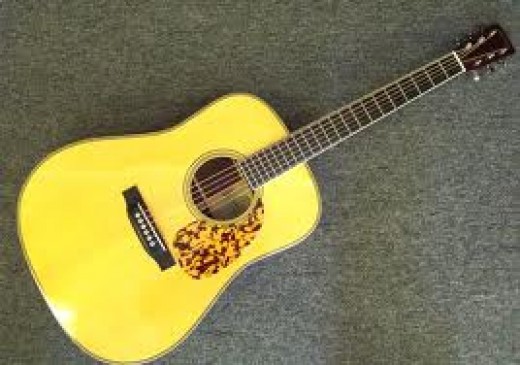

The Standard for Acoustic Guitars and Flatpickers, The D 28 by C.F. Martin & Co.

From the time I was twelve years old up until the time that I was a senior in high school, in Kaufman, Texas-I played the acoustic, and sometimes the electric guitar constantly.

My first name brand guitar was a Gibson LG-O, that my grandfather, Argus Troy, "A.T." Coker bought for me. The problem with that guitar was that I got it before my teenage growth spurt set in, and as I grew larger. . .. that guitar became too small for me, and the time came for an upgrade, not only in the size of the instrument I needed, but the quality of instrument as well. I was playing non-stop then, and it seemed a realistic possibility that I might turn out to be a professional musician.

It's not that the Gibson was a "bad" guitar, Gibson doesn't MAKE "bad guitars." The thing was just too small for me, and I was quickly turning into an impressive flatpicker at that time-and the Gibson wasn't a guitar that produced a loud, clear enough tonality for my talent or playing to be heard-especially when playing with other people. Acoustic guitars are never as loud as a fiddle, a mandolin, and certainly not loud enough to be heard alongside a banjo.

Luckily for me, my guitar instructor, a man named Scott Miller, was very well liked by my entire family, and indeed, the entire community here in Kaufman, Texas. Scott went to my parents, and my grandfather and said something like, "Look, Todd has some real potential-and what he really needs is a professional quality guitar on the level of a Martin D-28."

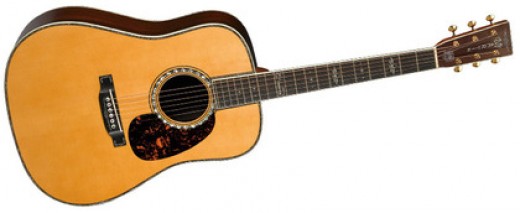
The C.F. Martin & Co. D 28 Vintage Reissue. I've owned one - very tough to beat.

Martin D-28 Vintage Reissue

The Martin D 28 - It's an American Classic with more years of credibility than the competition.

A pre-war D-45
A pre-war D-45

Martin Guitars-Legendary for Sound and Playability.

No, the statement by Mr. Scott Miller, my guitar teacher didn't alert me to the quality of Martin guitars, or their D-28. It was something that I'd long been aware of from spending countless hours with my grandfather, A.T. Coker. In fact, I already knew much of the history of C.F. Martin & Co because of him, and I even knew a lot about tonewoods, and bracing, and even more. What surprised me was that I'd achieved a level to where folks would actually present the idea in public that I should have such a fine instrument!

C.F. Martin & Co. has ALWAYS been the standard by which other guitars were measured, but I'm not exactly certain when the D-28 became their standard bearer. I suspect that it was in the 1960s when Doc Watson, and Clarence white-and the folk music revival became a cultural phenomenon of benefit to us all.

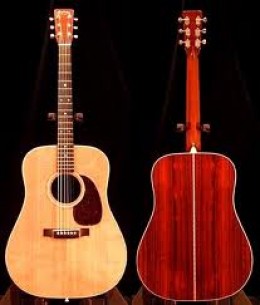
The D 28, Solid Spruce Soundboard, High X Bracing, and Solid Rosewood Back and Sides.

I'm told that this is actually pictures of a 1955 D-28 that belonged to Elvis Presley.
I'm told that this is actually pictures of a 1955 D-28 that belonged to Elvis Presley. | Source
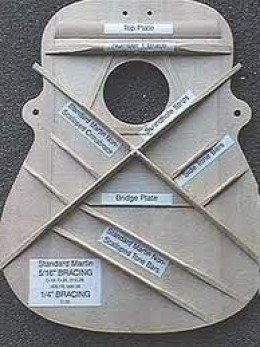
THE HIGH X BRACE.
THE HIGH X BRACE. | Source
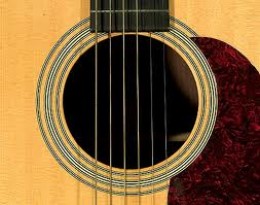
Herringbone trim
Herringbone trim | Source

Essential Specifications, and The "High X"

So Todd, what is it that make the Martin D-28 so special, besides the company that you seem to think so highly of, and the fact that it's a pop culture item in the world of acoustic guitarist?

Well, first of all, the D-28 is a full sized "flat top," or dreadnought guitar that is designed for folk and bluegrass style guitar playing. It's constructed of all solid wood-which in and of itself makes it a very fine, expensive, heirloom quality instrument. It's a "steel string" guitar, which means that, basically, it's not a classical guitar, or a guitar that you put nylon strings on-but there is absolutely no limitations to the types of music that can be, and are played on the Martin D-28. As for names of the famous, and not so famous, but equally great guitarist and musicians that own, and play this wonderful instrument-the list is too long to ever have been created. The chief and essential specs of the Martin D-28 are that it has a solid spruce

soundboard, and solid rosewood back and sides. There are, however, many different combinations of rosewood and spruce that have been used in the past, and are still being used today in this model guitar.
Besides the solid rosewood and spruce, the "X" brace is an essential design characteristic of the Martin D-28, and the picture to the right is more specifically, of the HIGH X BRACE. There was a time when Martin guitars deviated from there classic "high x brace" and went to using what I'll call "merely an x brace." The thing is, the classic high X brace allows the solid spruce soundboard to vibrate more freely, and produce a longer sustaining, louder, more quality tonality.

The next picture down is a closeup of the D-28 soundhole, and it's herringbone trim. Again, there have been D-28's produced without the herringbone trim, and those are typically the D-28 guitars that also do not feature the high X bracing. Those guitars without those specs are still bound to be wonderful guitars-but they may be more useful as a rhythm guitar, rather than a guitar that will be used for playing leads.

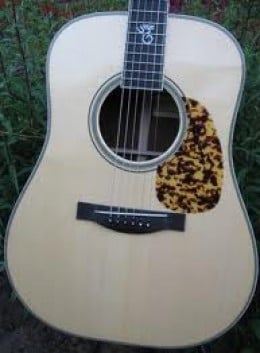
Wesman Todd Shaw, and His Santa Cruz D 28 Copy.

Me and my 1984 Santa Cruz Model "D)
Santa Cruz Tony Rice Guitar
Santa Cruz Tony Rice Guitar | Source
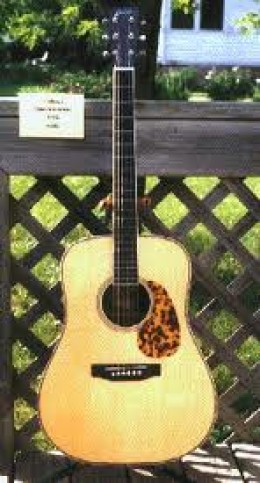
The Collings Clarence White Guitar.

The Highest Form Of Flattery.

There are literally more luthiers and small, or even large companies making variations or outright copies of the D-28 than I could ever mention in one single hub. I owned a Martin D-28 Vintage Reissue at one point, and it was truly a fabulous guitar-that I purchased new for less than two thousand dollars. Martin makes many D-28s, and if one wanted and was able to go all out that person would be buying the Martin D-28 GE, or "Golden Era," which features the Brazilian rosewood back and sides, and the Adirondack spruce top. The Golden Era guitar, take a deep breath, sells for around $9,000.00

So, if you recall the story up above-about me, and needing a great guitar that would last me the rest of my life. . .what did I wind up with? Well, I saved my pennies, and I saved my dimes-and I landed a winner that I've never thought once about parting with, and it's made by the wonderful Santa Cruz Guitar Company, in Santa Cruz California-where they still hand make their guitars.

If you'll notice the guitar underneath the picture of me and my Santa Cruz, you'll be looking at what I call a "super D-28," and it's the Santa Cruz Tony Rice Model Guitar. Look at the picture below that one, and you are seeing another "super D-28" and it is a Collings Clarence White guitar. Let me explain: The TonyRice model Santa Cruz, and the Collings Clarence White model are virtually identical as they are both copies, VERY fine copies of one particular guitar, and that is the 1935 D-28 that belongs to Tony Rice.
Huh? Then why is one called the "Clarence White Guitar?"

Because Clarence white was killed by a drunk driver a very long time ago, and Tony Rice owns his guitar now. It's probably the single most famous Martin D-28 in the world. I should also mention that neither one of these guitars match a classic D-28, as they were designed to match the particular one that Tony Rice ownes-and that one has been modified a good bit. I'll also mention here that I bought my guitar from John Hollman, the man who designed the Collings Clarence White for Bill Collings-who I've also met on one occasion. Any and every D-28, or accurate D-28 style guitar is bound to be a wonderful instrument should it be constructed with the traditional solid woods mentioned.

Conclusion

I hope you've enjoyed reading some here about the famous American guitar Icon, the Martin D-28, and the two other TOP OF THE LINE companies that also make a D-28 style guitar, and in fact, they  each make SEVERAL D-28 style guitars. Please don't be upset if I've left out your favorite company, and it's D-28 style guitar-there are far too many for me to even mention the ones that I know about, and have had my hands on. We'll do them justice another time. As always, never hesitate to contact me with any feedback or suggestions in the comments, or with a message. Thank you!

The Beautiful Martin D-180

Marking the one hundred and eightieth anniversary of C.F. Martin guitars in the USA, the D-180 is a stunningly beautiful guitar.

The Martin D-180 Commemorating the 180th anniversary of CF Martin & Co.

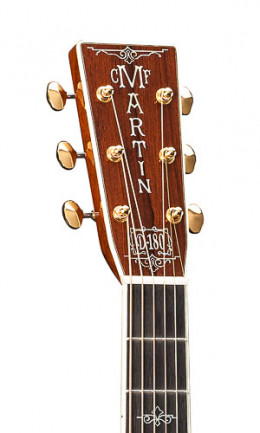
The Martin D-180 Head Stock

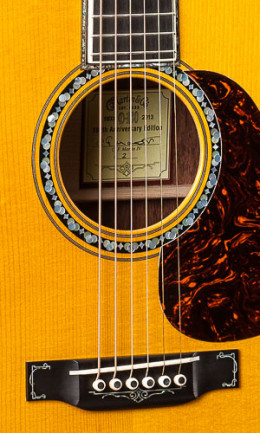
The Martin D-180 and the Most Beautiful Rosette I've ever seen.

That rosette is amazingly gorgeous!

The Martin D-180, A Guitar To Lust After

To commemorate the one hundred and eightieth anniversary of their existence, C.F. Martin & Company created one of the single most beautiful acoustic guitars ever seen. This guitar is stunning in every way, visually, tonally, and historically. It's a celebration of the world's finest and most celebrated acoustic guitar manufacturer, really, and C.F. Martin & Company are definitely a thing to be celebrated.

If you're like me, then you literally lust after guitars for their play-ability, tonality, and beauty. This D-180 by Martin is going to be something like a super swimsuit model to people like you and I. A trophy guitar. We all know such things cost a lot of money, and this D-180 is no different, it's very pricey. I'm seeing them new online for $13,999. Probably less expensive than any swimsuit model, and it's definitely less expensive than a corvette, but to persons like me, probably something I'd appreciate more than either.

While this Martin D-180 is very expensive, it isn't anywhere near the most expensive guitar Martin makes or has made. Instruments like the D-50 Koa Deluxe are more expensive instruments, and then there are even more expensive ones still. This guitar, however, and in my opinion, is more beautiful than those. So far as similar guitars, well, there are none insofar as the exquisite abalone inlay on this instrument goes, but as this is a guitar with Madagascar rosewood for its backs and sides, the Martin D-45 Madagascar is one to consider as an alternative.

Just what is it which makes me think this particular dreadnought out of all the many models ever made by Martin is the single most attractive of them all? What's so special about this thing anyway? Well, to me, it's the abalone inlay. I think of the rosette on this thing as the very most beautiful one I've ever seen. Another of the major points of beauty here are the finger board or fret board positioning markers, and those are entirely unique to this instrument as also is the lower inlay on the head stock.Now I know others may not care for it at all. I've no problem with that, some folks prefer the pure simplicity of a Martin D-18, and you'd best believe that I do as well, I've owned a D-18 in the past, but to me, this D-180 is without question the most attractive guitar to my tastes.

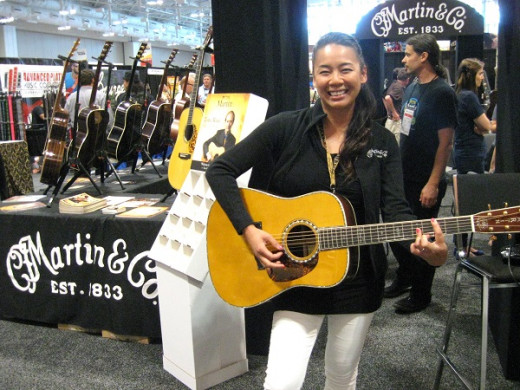
A Lovely Woman and a Martin D-180

Source

The Martin D-180 Specifications

So far as the specifications for this guitar go, it is a D-45 built to golden era specifications except that the particular rosewood used is from Madagascar and not Brazil. The other major differences are the abalone inlay, which is unique to this guitar. It's plain and simple to see that nowadays Madagascar rosewood is a big deal, and it seems as though most everyone wants to own a Madagascar rosewood dreadnought. Essentially, it is a very attractive wood with more coloring and grain pattern variety than is East Indian rosewood, but were you blindfolded and handed various and sundry instruments, some with the Madagascar rosewood and others with the East Indian variety, you're not going to be able to tell which guitar is of one wood and which is of the other.

Of course the soundboard is of Adirondack spruce. Adirondack spruce is sometimes called red spruce, and is thought to be the finest variety of spruce for use on guitars, and so it is generally only found on a builder's very best of instruments. If you are able to buy one of these guitars, then buddy, I am jealous of you. If you're a player and interested in the purchase of the Martin D-180, then it's a very good bet you've already got a few Martin instruments in your home. If I were that person, then I'd likely recommend not playing this guitar too very often, or at least not taking it out and about, as keeping it as close to mint condition as possible well help this sure fire investment rise in value as the years go by. Other specifications are as follows:

- Construction: Mahogany Block/Dovetail Neck Joint
- Body Size: D-14 Fret
- Top: Solid Adirondack Spruce
- Rosette Style: Unique to this guitar
- Top Bracing Pattern: Standard high "X" (Golden Era Style), Forward Shifted
- Top Braces: Solid Adirondack Spruce 5/16''
- Back Material: Solid Madagascar Rosewood
- Back Purfling: D-45 Golden Era
- Side Material: Solid Madagascar Rosewood
- Endpiece: Grained Ivoroid
- Endpiece Inlay: Black/Maple/Black Fiber
- Binding Grained: Ivoroid
- Top Inlay Style: Style 42
- Side Inlay: Select Abalone with Black/Maple/Black Fiber
- Back Inlay: Black/Maple/Black Fiber
- Neck Material: Select Hardwood
- Neck Shape: Modified V
- Nut Material: Bone
- Headstock: Solid/Long Diamond/Square Taper
- Headplate: Solid Madagascar Rosewood
- Heelcap: Grained Ivoroid
- Fingerboard Material: Solid Black Ebony
- Scale Length: 25.4"
- # Of Frets Clear: 14
- # Of Frets Total: 20
- Fingerboard Width At Nut: 1-3/4"
- Fingerboard Width At 12th Fret: 2-1/4"
- Fingerboard Position Inlays: 180th Anniversay Design
- Fingerboard Binding: Grained Ivoroid
- Finish Back & Sides: Polished Gloss
- Finish Top: Polished Gloss w/ Aging Toner
- Finish Neck: Polished Gloss
- Bridge Material: Solid Black Ebony
- Bridge Style: 1930s Belly w/ Drop-In Long Saddle
- Bridge String Spacing: 2-5/16"
- Saddle: Bone
- Tuning Machines: Waverly Gold 4060 w/ Butterbean knobs
- Bridge & End Pins: Fossilized Ivory w/ Black Pearl Dots
- Pickguard: Delmar Tortoise Color
- Case: 545 Geib style w/ 180th Anniversary Design
- Interior Label: Signed by CFM IV - Numbered in Sequence without Total

Wednesday, September 21, 2016

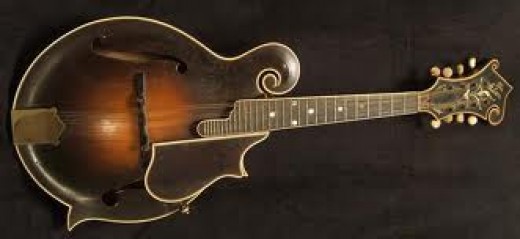
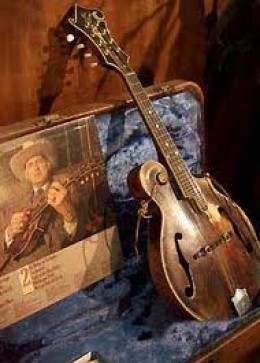
The Gibson F5 Mandolin

Besides making world class acoustic and electric guitars - Gibson also makes what is easily the world's most loved, desired, and most easily recognized mandolin, the Gibson F5.

The Gibson F5 Mandolin

I've been a huge acoustic and electric guitar music fan my entire life. Primarily I've always played acoustic guitars - but spent a lot of time listening to all kinds of guitar music. But the guitar is only one of the stringed instruments out there - and it's not always been the stringed instrument that has got or deserved the most attention. The violin, or fiddle is that instrument, but the guitar has a bit of a cousin, or maybe "step cousin," that is a closer relative to the violin than anything else, and that is the mandolin. I love hearing a mandolin being played, and especially should it be played well. No mandolin in this world is more famous or desired than is the Gibson F5 mandolin - a truly legendary instrument who's legend not only will not go away, but continues to grow.
Source

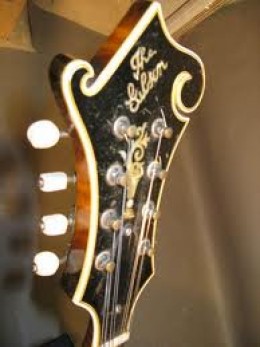
The Beautiful Gibson F5 Mandolin Headstock

Source

Lloyd Loar, and the Gibson F5 mandolin

During the early part of the 20th century many of the world's finest acoustic instruments were made. Primarily C.F. Martin & Co. and the Gibson corporation made these instruments, and perhaps the most famous American luthier then, and now was a man named Lloyd Loar, the designer of the Gibson F5 mandolin, and the Gibson L5 guitar. Of course Lloyd Loar designed other instruments as well - but none of them will ever have quite the same level of admiration among the masses as does the Gibson F5.

It's tough to compare anything to the legendary work of Stradivarius, but a Lloyd Loar Gibson F5 mandolin is an American instrument that in time will have that level of respect, awe, and admiration. Lloyd Loar has been out of mandolin making for a long time, and of course Gibson still makes the F5, and of course the F5 is still an amazing instrument, and the preeminent mandolin for folk, Celtic, and Bluegrass, and many another genre of mandolin to own.

Hey, perhaps you are an ambitious but very skilled woodworker, and want to build your own F5 mandolin - I've got just what you want and need right here, buy the amazon.com F5 mandolin template just to your right, and have at it. Please let me know personally if and when you do this, and build your mandolin. I want to know. I want to see it - heck, I want to play it!

The Beauty Of The Gibson F5 Mandolin

Source

The Beauty of the Gibson F5 Mandolin.

The beauty of the Gibson F5 mandolin is obvious to the eyes. Just look at the thing. Clearly a master woodworker had to have created it. It's not going to be something just anyone could do, and before the Lloyd Loar F-5 mandolin was produced by Gibson - mandolin's typically had a rather plain, pear shape as a rule. Now, you don't have to have an F5 to have a beautiful mandolin, and for the most part - the beauty of a mandolin is in it's SOUND - so clearly there are many another great mandolin out there, and trust me on this one, just because Gibson makes the F5, that doesn't mean that the design of the Gibson F5 isn't copied by, literally, hundreds of other mandolin manufacturers.

Just as we see with the classic designs of Martin acoustic guitars - the F5 design is copied in cheaper instruments, and even higher end instruments than the original. If you buy a NON Gibson F5 copy - then be certain that you do your research to find out just what exactly the value for that specific mandolin is before you buy it. Looking like an F5 in no way means that a mandolin is anywhere near the value of an F5.

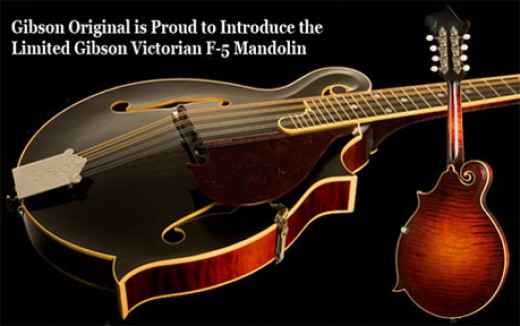
The Gibson F5 Mandolin Specifications.

With a solid spruce arched top and carved "F" sound holes and solid figured maple backs and sides - these fine mandolins are truly an investment, they aren't toys, and the price will definitely let you in on that fact. One needs to realize that the wood working involved in the creation of a masterwork such as the Gibson F5 is very, very taxing and precise. The people that own these mandolins make a living from playing them very often - and if not, they make side gigs for pay, or often give lessons for pay. Buckle yourself in, the Victorian Model F5 goes for around $15.999,00. Do you see what I mean? Now, just like a Martin D 28 or D 45 - there are less expensive versions of these - but they are going to start out new at about $7,000.00. These are definitely PROFESSIONAL grade instruments.

Hey, I've had my hands on one for a week at a time before - but someone went out of town, and thought it safer at my house with me than either left in his home alone, or on the road with him. Call me "Lucky."

The Gibson F5 Victorian Limited Edition Mandolin.

Conclusion.

One does not need to own a Gibson F5 mandolin to make beautiful mandolin music - and neither does one need to own a Gibson F5 to learn to play the mandolin. These mandolins, and especially the GOLDEN GOOSE models actually made by the designer, Lloyd Loar, are the premier mandolins in the entire world. It was my purpose here to merely introduce you to these instruments should you not know about them. A good beginner's level mandolin can be had for a bit over $500.00 new, and if you shop around in pawn shops while having researched mandolins on the internet, then you might come away with a real bargain in a used one for considerably less.

 The facts are though, that if you come across a real Gibson F5 - you need to be serious when you talk to the owner about buying it. If it's stolen, then you are on your own, and should the wrath of the owner come upon you - that's your problem to deal with.

The Gibson J 200 Guitar and The Gibson SJ 250 Monarch

When it comes to high end, very expensive, and beautiful steel string acoustic guitars - people most often think of Martin guitars, or Gibson guitars. Now, there are many, many other guitar manufacturers making beautiful steel string guitars, but surely Martin and Gibson are the best known. When it comes to flatpicking steel string acoustic guitars, however, nobody beats Martin - but then again Gibson has it's massive, beautiful, and loud J 200, and it's even more expensive and beautiful sibling the J-250 Monarch.

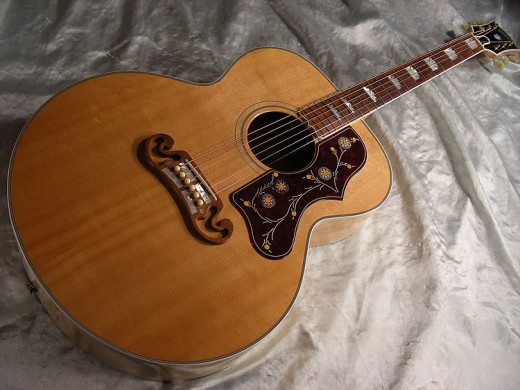
The Gibson J 200

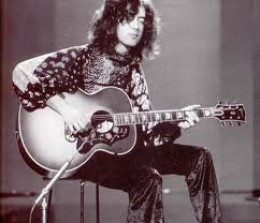
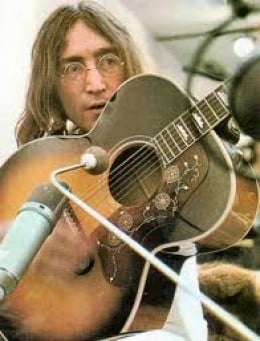
Jimmy Page, Elvis, and John Lennon all Played the Gibson J 200.

Jimmy Page used a J-200 for a lot of the acoustic guitar on the first Led Zeppelin album.
John Lennon and all the Beatles forever preferred Gibson and Epiphone guitars.
Elvis Presley always used either a Gibson or a Martin guitar.

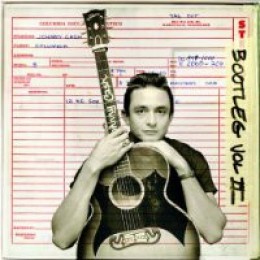
Johnny Cash, Another Great With A Gibson J 200.

Source

The Gibson J 200, a Loud Jumbo American Guitar Classic.

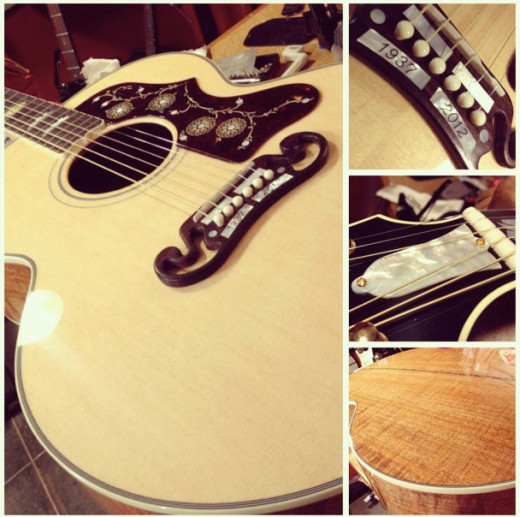
The Gibson J 200 debuted on the American music scene, and indeed, the entire world in 1937, during the era that had been called "the golden era" of American acoustic guitars. It's said that the J 200 is the most famous acoustic guitar in the world. That might be true, or it could be that the Martin D 28 is the most famous acoustic guitar in the world. I think the answer here is more a matter of opinion than fact.

The Gibson Guitar company has always competed with C.F. Martin & Co. for top slot in quality, reputation, and sales of acoustic guitars in America, and the entire world. When it comes to competition with Martin guitars, the Gibson J 200 is the one guitar that they produce that really CAN compete as a fine, high quality instrument for flatpickers. But the J 200 is much more than that.

So what is a J 200? Well, visually, just look at the thing! The "J" stands for "Jumbo," and the J 200 is certainly one of the largest, if not THE largest standard production model guitar in modern acoustic guitar manufacturing.

I considered for about a half a second that someone might wonder why I put James Patrick Page, and his picture above the pictures of Elvis Presley, and John Lennon. Are You Kidding ME? If you are reading this, then I assume that you are a guitarist, and no guitarist would question the order in which I placed those pics.

I found four prices for the base model J 200:
1. Gibson J-200 Studio Acoustic/Electric Guitar
$2,999.00Sam Ash
2. Gibson Elvis King of Rock J-200 Acoustic-Electric Guitar, Ebony
$3,549.00 - Amazon.com
3. Gibson J-200 20th Anniversary Acoustic Guitar Vintage Sunburst
$4,799.00 - Musicians Friend
4. Gibson J-200 Custom Acoustic-Electric Guitar, Antique Natural
$4,899.00 - Amazon.com

The Gibson SJ-250 Monarch.

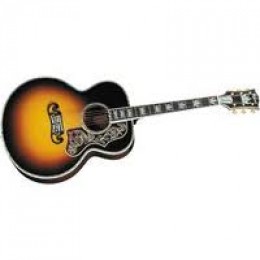
The SJ 250 Monarch

So what, then, is a SJ 250 Monarch? It's simply a fancier version of the J 200. It's not any bigger, but the "SJ" stands for "super jumbo," and it's definitely a super guitar. The SJ 250 Monarch also features more abalone, or "mother of pearl" inlay than does the J 200. It's a very similar appearance upgrade to what you see in the differences between a Martin D 28, and a Martin D 45. Also, it's tough to miss the beauty of the gold plated tuning keys that the SJ 250 Monarch features.

This wonderful, loud, and beautiful guitar has been priced between $19, 999.00 to $25, 771.00 new and retail.

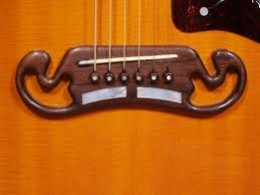
The Unique Mustache Bridge Found On the Gibson J-200 and SJ-250 Monarch

That Mustache Bridge!

Besides the fact that the Gibson J 200 and SJ 250 Monarch guitars are probably the largest production model acoustic guitar in the world, and that this beautiful instrument is the single best alternative to an upper level Martin acoustic guitar, or one of it's solid wood competitors, the "other" most distinguishing
characteristic that the Gibson J 200 features is it's unique and lovely Mustache bridge.

 With any J 200 or SJ 250 Monarch by Gibson, the customer is going to be paying a lot of money for one of these instruments. What should always be understood is that these instruments are heirlooms and investments, and not "just" fine guitars.

Solid Tonewoods.

When the Gibson J 200 debuted in the late nineteen thirties, it was made with a solid Adirondack "red" spruce top, and Solid rosewood back and sides. Later, the guitar's tonewood material for the back of the instrument and the sides was changed to solid Maple.

Now Maple is a traditional tonewood for stinged instruments, it's beautiful, can resist the tension produced by strings and tuning keys for lifetimes, and even the famous Stradivarius violins are mad of maple. Figured maple is always beautiful, but I'm told that figuring with Maple makes zero difference regarding the tone produced from it's use in stringed instruments. I have to admit that I'm completely influenced by a guitar's tone, and not much concerned with it's beauty.

 It's a musical instrument that we're talking about here, not a runway model. I've also been told that the Maple on these very large Gibson Jumbo guitars truly helps their tonality, and brings out their best characteristics because maple allows for clear separation of the notes, and helps overcome some of the boomieness of these large instruments.  Facts are, I want to play more guitars with solid maple back and sides, so as I can make some more pointed observations concerning their specific tonality, and tonal characteristics.

Today, the base model Gibson J 200 features solid Sitka Spruce for it's soundboard, and Solid maple for it's back and sides. It also has a rosewood fingerboard, rather than ebony.

Final Thoughts.

The Gibson J 200, and it's more expensive and beautiful brother or sister, the Gibson SJ 250 Monarch are amazing guitars, sound investments, and wonderful instruments of heirloom quality. They are exceedingly loud guitars, and this is their most valuable characteristic. A loud acoustic guitar is a million times more desirable to own than a quite one. These guitars are loud enough for someone to perform playing one without amplification, should the venue not be too large.

The SJ 250 Monarch is also a fine competitor to any of the C.F. Martin and Co. production model guitars of the Martin D 45 line. Both the Gibson and the Martin have huge amounts of fine, precision cut abalone inlay, and gold plated tuning keys.

Any Good solid wood Martin guitar is bound to be a loud guitar if played by a pro, who is trying to be heard. You can also "hot rod" most any acoustic guitar to make it louder, there are also some other things that can be done to increase a guitars volume, and I'm talking about doing so without adding any amplification. Or, you can buy a Gibson J 200, or even a Gibson SJ 250 Monarch. I've played these guitars, and they are the loudest guitars that I've ever played.

The Gibson J 200

Sunday, September 18, 2016

Django Reinhardt, The Gypsy Jazz Guitar Legend

Django Reinhardt is possibly the single most influential guitarist in the history of the instrument. Before Django it was VERY seldom that the guitar was every played as a lead instrument at all, and Django's style was technically astounding, even were he have had full use of his left hand, which he didn't.


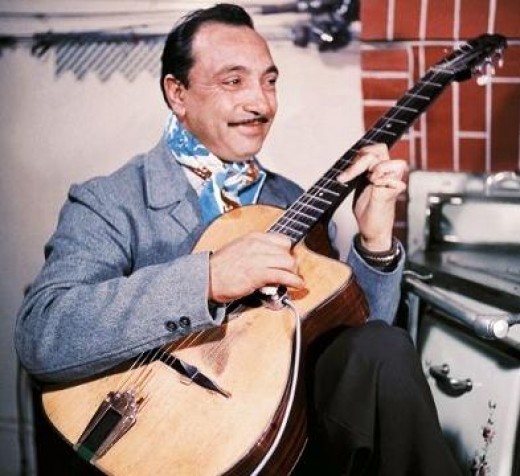
Django Reinhardt

Long before people like Doc Watson and Clarence White brought the guitar to the fore as a lead instrument in the minds of American musicians , there was Django Reinhardt. Django Reinhardt many years before the folk revival had proven to the world what an incredible voice the six string acoustic box had, and he'd already revolutionized the guitar as a lead instrument in the world of jazz. Not only that, he created his own form of music, a sub genre of jazz known as Gypsy Jazz.

The year was 1934, and the French as a people weren't into jazz - they considered it a lower class music. A man named Pierre Nourry, however, was determined to make jazz something special in France. He headed something called the Hot Club, but the Hot Club was not a club at all - it was a floating party of jazz enthusiast that held jam sessions when possible. Pierre was in a state of distress, as the musical leader of the club, a pianist named Freddy Johnson, was moving back to the United States.

Nourry had already met Django, and even had some records produced of his music, but the tunes were poorly received by John Hammond, the influential US music critic who'd made such a difference for other artists that he did like. Pierre was still un daunted, and determined to let Django lead his Hot Club band. Later, after performing for the legendary Andres Segovia, a French music critic would exclaim,

"It can be said that he was the revelation of the concert. He is a curious musician, with a style like no one else's. We have a great improviser in Paris!"

Django Reinhardt

Source

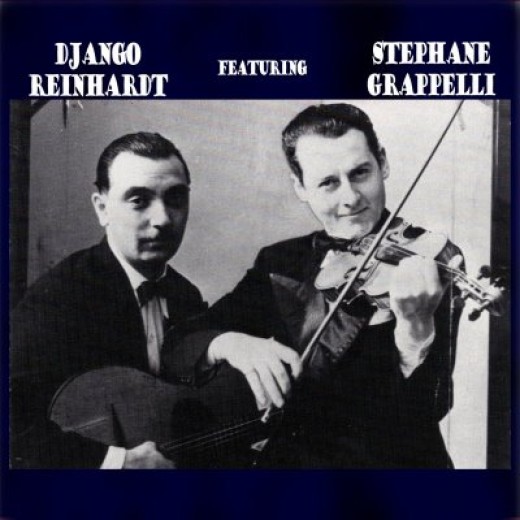
Django Reinhardt and Stephan Grappelli

Every great musician needs another musician to provide some back and forth with. Would we have ever come to know Paul Simon without him having Art Garfunkel? What about John Lennon? It's doubtful that without Paul McCartney, that we'd have ever heard much about either one of them.

Django Reinhardt might just be a little known footnote somewhere in the history of the guitar were it not for Stephan Grappelli. Oh certainly, Django had talent, prodigious talent - all on his own. But sometimes the whole is greater than the sum of it's parts, and when Grappelli and Reinhardt played together, it was as if worlds collided, musically. As for their first time to play together, Stephan had this to say,

"I still did not know Django very well, but sometimes I would sit backstage and listen to him play. One day to amuse myself, I started to play along with him. The effect pleased both of us, and we went on to play some more tunes. The next day we waited impatiently for the intermission so that we could go and play backstage again!"

Lots of folks who know music know a good thing when they hear it the first time, and Pierre Nourry knew he had a good thing going with the combination of Stephan's violin and Django's guitar. Pierre then hustled up another recording deal - this time featuring the beautiful improvised leads of both of them, and a back up band. In a time when a good jazz record would only sell a few hundred copies in all of Paris; the Hot Club's first recording with twin soloist, Grappelli and Reinhardt, captured the imagination and the favored pens of all Paris music critics.

Django Reinhardt and Stephan Grappelli

Source

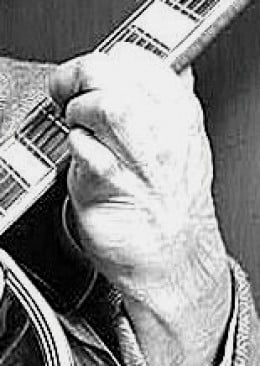
The Left Hand Of Django Reinhardt

Source

Django Reinhardt's Disfiguring Injury.

What is so hard to believe is that the music that Django Reinhardt played in his professional career - speedy, unique, intense, improvised, and altogether that of a genius - was all done with a severely disfigured fret board hand. The few people in the world who can play what Django played in his lifetime, are all doing that with four good fingers. Django Reinhart did it with only two with the exception that he could use his third and fourth fingers on the first two strings of the guitar.

What happened was that he had thought that he'd heard a mouse in his little caravan trailer that he and his new bride lived in. His wife had had the trailer full of celluloid flowers that she intended to sell the next day. On hearing some scurrying on the floor, Django took a candle and held it low to see, and he ignited the highly flammable cellulose, which started an instant bonfire inside his home. Django and his wife both escaped, but he was permanently disfigured. Doctors even wanted to amputate one of his legs, but he wouldn't have it, and left the hospital for a nursing home where he was given great care, and was able to keep his leg. He was only eighteen years old then, the year was 1928.

The Hot Club Of France

Source

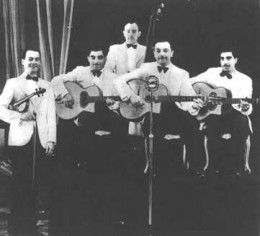
Quintette Du Hot Club De France.

The Hot Club of France had a few minor set backs at the start, but on February 23, 1935 - the five opened for jazz great Coleman Hopkins in Paris, and then began to attract ever larger crowds. Within a year they were touring all of Western Europe and with the biggest names in jazz music. By 1936 they were selling out all of their London concert dates faster than even Duke Ellington, and they did it all with a style of music that was totally unique. Django wrote most of the tunes, and there was no need for percussion because of the brash and abrupt three guitar rhythm section employing tremolo chords, syncopation, and tremendous energy.

The Hot club band, besides having Reinhardt and Grappelli, consisted of the rhythm guitarists Joseph Reinhardt (Django's brother) and Roger Chaput, and bassist Lois Vola. These, however, were only the primary and original members, and others came and went at whims or due to Stephan and Django's demands. I've got one album where Reinhardt is basically chastising his rhythm section during a tune - for sloppy play, and not keeping in time with him. He had absolute perfect pitch, and the slightest note out of key could infuriate such a man. Grappelli and Reinhardt would go on to record 339 tunes, in all, before World War Two.

What sets the Hot Club apart as a group is that they were the very first jazz musicians to gain acceptance as true masters of their art - that weren't Americans.

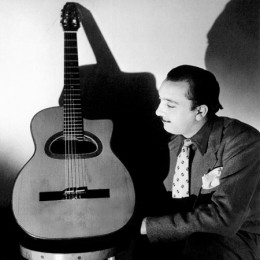
Selmer Maccaferri Guitar, and The Incomparable Django Reinhardt.

Source

Django Reinhardt, Style and Legacy.

It's not much of an exaggeration to say that whether or not you care for the jazz of the Hot Club of France, that no guitarist has ever been as influential as has been the play and style of Django Reinhardt. The highly charged lyricism of his work is very conversational in sound. He sounds as if he's singing or even sometimes, screaming at you through his guitar solos. Characterized by intense energy, staccato notes, octave lines, and lyricism - Django's technique is astounding, it moves into the area of being almost unbelievable when one realizes that he only had two fully functional fingers to work with.

Django Reinhardt was a Tzigane, a Romanian Gypsy born in a Gypsy caravan near Charleroi Belgium in 1910. Gypsy men were often (and still are) more fond of living by their wits than by the conformity of steady employment, and that leaves lots of time for playing music. I suspect that they sometimes enjoy their lives, by and large, more than the common conformist does.

At twelve years of age Django got his first instrument, a banjo with a guitar neck on it; but thirteen he was accompanying his uncle and playing in clubs. At sixteen years of age Django made his first recording with an accordionist named Jean Vaissade - Django's name appeared on the record as Jiango Renard - Django Reinhardt had attended exactly one day of school in his entire life.

The fire that disfigured the man at a very young eighteen years of age had to have been exceedingly traumatic for him. He had to re learn the entire instrument while only using two fingers. Luckily for Django, and the rest of the world - his index and middle fingers on his left hand were both very long. It's been asserted with Django as proof - that musicianship is more a mental skill than a physical one.

It's has been said that Django could NOT play out of tune, out of key, or ever make a mistake even. He could play any tune in any key at any time he desired. While he didn't even know what the names of the chords of anything were - he was more acutely aware of them than perhaps anyone has ever been.

Gypsys during world war two were put into gas chambers as were any deemed retarded, mentally ill, homosexual, or Jewish. It's a sad thing of history that really only one of those groups seems to get remembered. It's lucky indeed for Django that he was a star to the Germans as he was to everyone else. During his lifetime he was truly a world wide celebrity. During his life, however, Django Reinhardt's music wasn't appreciated in America.

In his final years Django adopted with the changes in the seas of time, and incorporated bebop into his style, making it, of course, his own. He even started dabbling with the electric guitars which he'd previously been so suspicious of. After a night of playing in a Paris nightclub in 1951, he suffered a brain hemorrhage and fell dead on a rail station sidewalk. The impression he left, and the entire style of music that he'd created almost single handed, however, will live on so long as Humans do.

Twitter Delicious Facebook Digg Stumbleupon Favorites More

 
Design by Free WordPress Themes | Bloggerized by Lasantha - Premium Blogger Themes | Laundry Detergent Coupons